CPO/Head of Product (Audience)
AI in Product Management (Pillar)
CEO/GM (Audience)

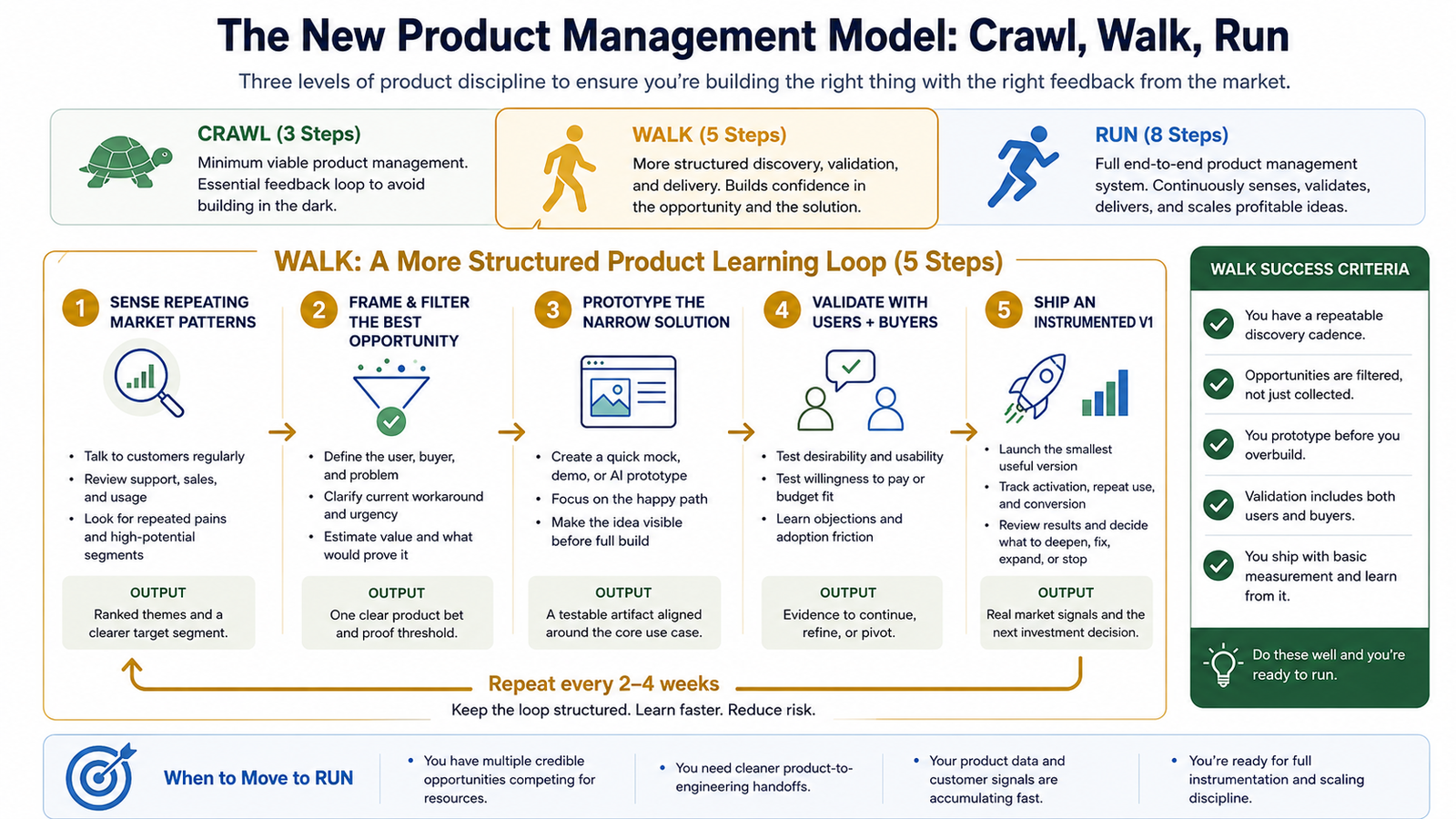
Crawl helps an early company survive. Walk makes it structured. But as the company grows, more customers, segments, usage data, sales objections and competing opportunities pile up, and Walk is not enough.
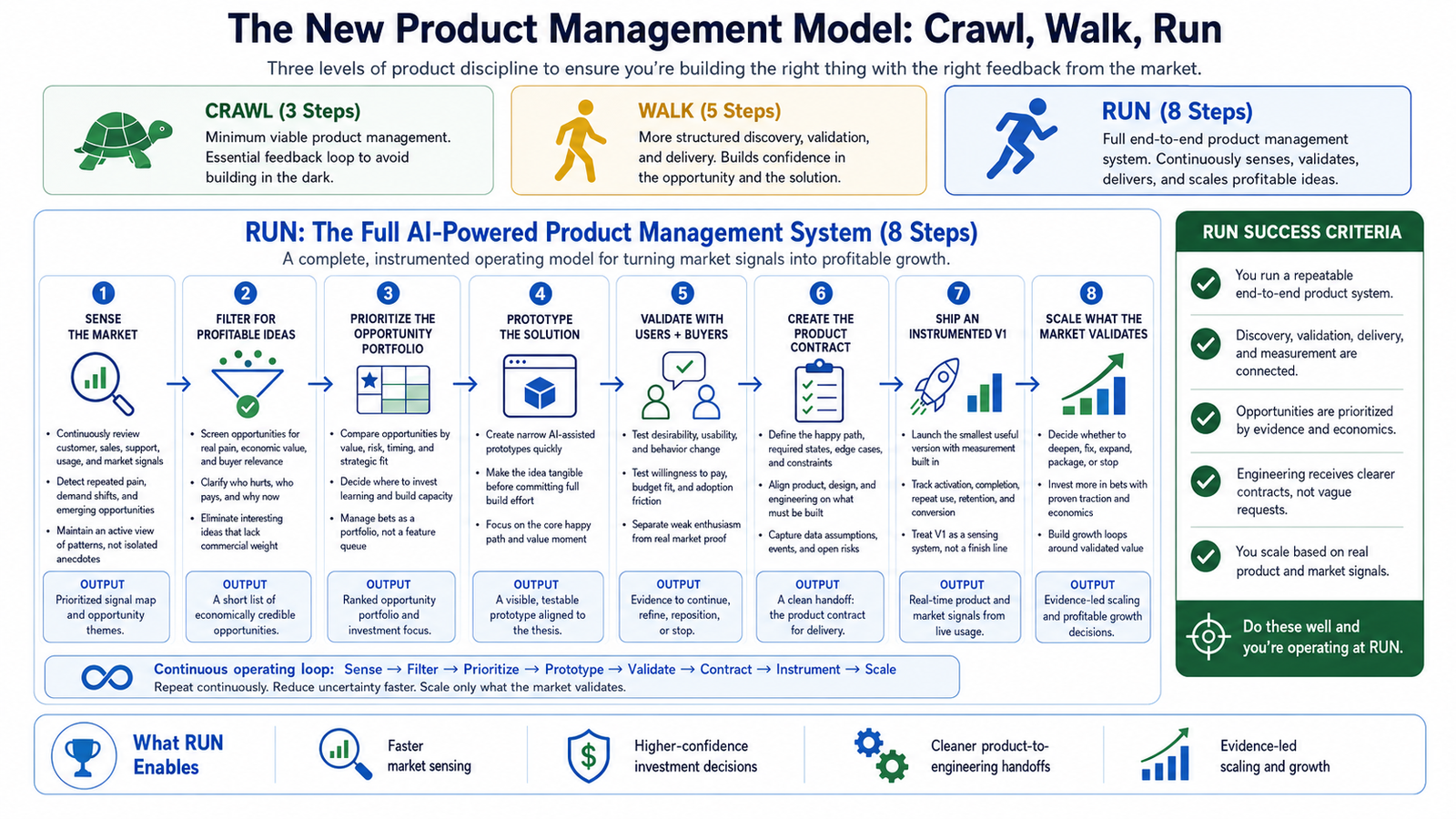
That is when the company needs the Run version of the new product management model: the full AI-powered system, from market ambiguity to profitable growth.
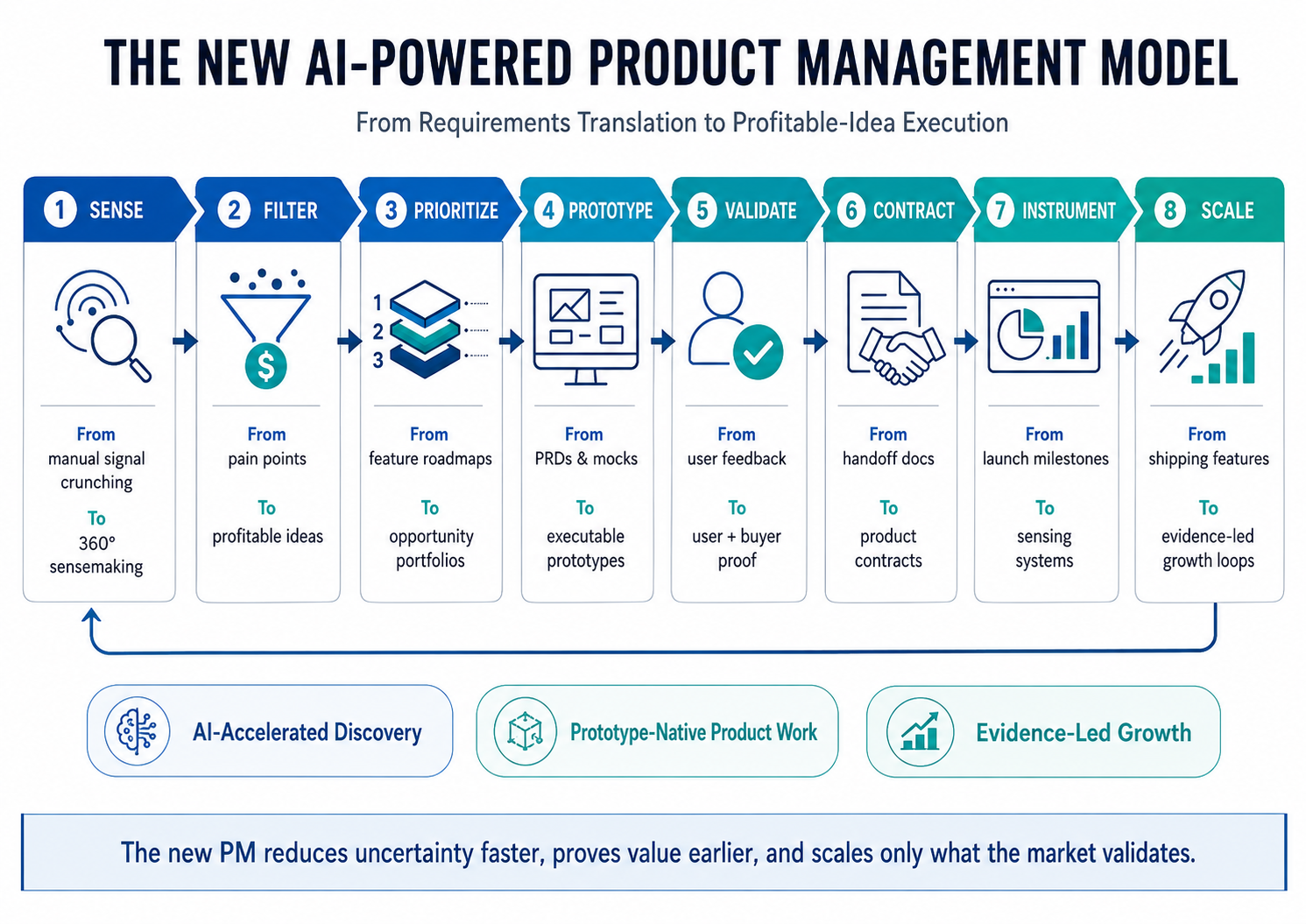
Sense → Filter → Prioritize → Prototype → Validate → Contract → Instrument → Scale
Run continuously. Reduce uncertainty faster. Scale only what the market validates.
What to do
Book a working session if you want help putting this system in place.
Many companies think product maturity means building faster. The point of Run is higher-quality speed. A company operating at Run can answer:
Shipping more is not the goal. Outcomes are (Perri, 2018).
Move from Walk to Run when the five-step loop produces more opportunity, data and decisions than the team can manage informally:
The company is no longer looking for any bet that works. It is deciding which validated bets deserve more investment.
Crawl listens for one problem. Walk senses repeating patterns. Run makes sensing a system: customer conversations, sales objections, support themes, product analytics, onboarding friction, churn reasons, expansion requests, competitive moves and analyst signals, reviewed continuously.
Where is pain, demand, risk or opportunity accumulating faster than our roadmap reflects?
AI materially expands capacity here. It can cluster open-ended feedback, summarize sales calls and surface patterns across accounts. In a small McKinsey study of 40 product managers, generative AI improved PM productivity by 40 percent (Gnanasambandam et al., 2024). But AI does not decide what matters. AI gathers; people decide.
Output: a prioritized signal map and opportunity themes.
A mature product organization has no shortage of ideas. AI generates even more. The problem is not idea generation. It is idea selection.
A profitable idea clears five tests: the pain is real, the pain is expensive, the buyer is identifiable, the solution is adoptable, and the economics can work. Ask who hurts, who pays, what the problem costs today, and what evidence would justify deeper investment.
Output: a short list of economically credible opportunities.
At Walk, the team picks the next bet. At Run, it manages several at once. Some are large but uncertain, some small but obvious. Some protect retention, some unlock expansion, some are attractive but too early.
Track each opportunity by segment, problem, buyer, expected value, confidence, risk, evidence collected, next learning action and investment required. Rank by evidence and confidence, not by who asked loudest (Gilad, 2023).
Output: a ranked opportunity portfolio and investment focus.
At Run, prototyping is a core capability, not an occasional exercise. AI lets PMs, designers and engineers build narrow, clickable prototypes early.
The discipline matters. Tie each prototype to a clear thesis, focus on the happy path, expose the value moment, and never pretend it is production-ready.
Output: a visible, testable prototype aligned to the thesis.
Users tell you whether the workflow makes sense, whether they would change behavior, and what would block adoption. Buyers tell you whether there is budget, urgency, a reason to switch, and a price that works. Usability, value and viability are separate risks (Cagan, 2017).
Look for behavior and commitment, not compliments (Fitzpatrick, 2013). A mature product organization stops attractive ideas when the evidence is weak. That is one of the most valuable things product management does.
Output: evidence to continue, refine, reposition, or stop.
This is the biggest difference between Walk and Run. The product contract replaces vague handoff documents. It is not a giant PRD. It is a compact record that preserves intent as the idea moves into production:
What must engineering know to build the right thing without reverse-engineering the business logic?
Output: a clean handoff: the product contract for delivery.
In Run, launch is a sensing system, not a milestone. Before release, define the value moment, the behavior that proves a user reached it, and the activation, repeat-use, retention, conversion and failure signals that matter (Croll & Yoskovitz, 2013). Decide in advance what you will do with the results.
Output: real-time product and market signals from live usage.
Scaling is not automatic. A launched product may need to be deepened, fixed, expanded, packaged, priced, repositioned, integrated or stopped. Ask: did users reach the value moment and come back? Did conversion, retention or sales velocity improve? Did the economics strengthen?
Output: evidence-led scaling and profitable growth decisions.
The company does not scale what was merely shipped. It scales what the market validates (Ries, 2011).
Run needs an operating cadence, not just a diagram. Five standing reviews keep it working:
Run needs a real product function with clear ownership: a head of product, a senior PM, or a product trio of PM, design and engineering working closely with sales, success, data and finance. The owner is not a roadmap manager. They are responsible for the product operating system, from market signal to scaling decision. That is why the PM must own problem selection and judgement.
A company is operating Run well when five things are true:
Do these well and you are operating at Run. What it enables: faster market sensing, higher-confidence investment decisions, cleaner product-to-engineering handoffs, and evidence-led growth.
Continuously sense the market. Filter for profitable ideas. Prioritize the best opportunities. Prototype before overbuilding. Validate with users and buyers. Hand off with a product contract. Instrument the first release. Scale only what the market validates.
Crawl helps a company avoid building in the dark.
Walk helps a company build confidence before it invests.
Run turns product management into a full system for profitable growth.
Want help installing the system? Book a working session.
Cagan, M. (2017). The four big risks. Silicon Valley Product Group. https://www.svpg.com/four-big-risks/
Croll, A., & Yoskovitz, B. (2013). Lean analytics: Use data to build a better startup faster. O’Reilly Media. https://www.oreilly.com/library/view/lean-analytics/9781449335687/
Fitzpatrick, R. (2013). The mom test: How to talk to customers and learn if your business is a good idea when everyone is lying to you. https://www.momtestbook.com/
Gilad, I. (2023). Evidence-guided: Creating high-impact products in the face of uncertainty. https://itamargilad.com/book-evidence-guided/
Gnanasambandam, C., Harrysson, M., Singh, R., & Yarlagadda, C. (2024, May 31). How generative AI could accelerate software product time to market. McKinsey & Company. https://www.mckinsey.com/industries/technology-media-and-telecommunications/our-insights/how-generative-ai-could-accelerate-software-product-time-to-market
Perri, M. (2018). Escaping the build trap: How effective product management creates real value. O’Reilly Media. https://melissaperri.com/book
Ries, E. (2011). The lean startup. Crown Business. https://www.penguinrandomhouse.com/books/306999/the-lean-startup-by-eric-ries/
Torres, T. (2021). Continuous discovery habits. Product Talk. https://www.producttalk.org/continuous-discovery-habits/
The New Product Management Model series