CPO/Head of Product (Audience)
AI in Product Management (Pillar)
CEO/GM (Audience)


If your PMs believe the CEO, Sales, head of CS decides the roadmap, you have a hidden governance failure. You are spending large amounts of money on engineering time while under investing in one job. That job is choosing the right problems and making the right bets. In modern product orgs, PM is stewardship over scarce resources. It is closer to a fiduciary mindset than a ticket shepherd.
What to do.
Book a working session and get a toolkit on Substack.
What this looks like in the business (symptoms)
You will usually see several of these at once.
PMs say their job is to align stakeholders and get decisions made, but they cannot explain why the team is building what it is building.
Roadmaps behave like a voting system. The loudest function wins. The PM acts like a facilitator.
The CEO or CPO believes the system is fair because many people are in the room. The company confuses group input with accountability.
PMs spend time collecting opinions and writing requirements. They do not spend time choosing.
Discovery exists as a phase. It happens before a project. It does not happen every week. (Torres, 2021).
Post launch learning is weak. Teams ship. Then they move on. Revenue, retention, activation, and expansion do not move. Or they are not measured. (Perri, 2018).
Junior PM is treated as a normal entry job. The org hires for polish and follow through. It does not hire for judgment.
Engineers feel blocked, so PMs respond by over specifying solutions and turning uncertainty into paperwork. That increases waste and reduces learning. (Ries, 2011).
These patterns are not a motivation problem. They are a role clarity and decision rights problem. Role ambiguity and role conflict are strongly associated with worse performance and more stress. (Rizzo et al., 1970; Tubre & Collins, 2000).
How it impacts revenue and competitiveness
When PM does not own problem selection, four costs compound.
You spend engineering salaries on low value work. Most B2B SaaS companies are converting cash into code. If the bet is wrong, the burn still happened. The loss is real.
You get false confidence from motion. You shipped. You closed tickets. You held reviews. None of that proves value. (Perri, 2018).
You slow the learning rate. If teams do not run small tests, they cannot update their beliefs. They keep building. This is how you build the wrong thing faster. (Ries, 2011).
You weaken accountability. When selection is shared, ownership is shared. When ownership is shared, outcomes become nobody’s job. Agency theory is blunt about this. When the actor is not clearly accountable to the principal’s outcomes, incentives drift and cost rises. (Jensen & Meckling, 1976; Eisenhardt, 1989).
This is why PM is a massive responsibility. It is not being in meetings. It is deciding how the company places bets with limited time and money.
Why it happens (root causes)
This failure mode is common, even in well intentioned orgs.
The company never defined selection as a job. Many leaders believe discovery and prioritization are a group sport. They treat the PM as a neutral coordinator. The PM becomes a conduit for preferences.
The org treats product as a service. Sales asks. Support asks. Leadership asks. Product delivers. Over time, the PM learns that refusing work is punished and accepting work is rewarded.
Decision rights are vague. Everyone can propose. Nobody can say no. Backlogs become a queue of requests, not a portfolio of bets. (Schwaber & Sutherland, 2020).
The company confuses seniority with title. A junior PM can learn craft. A junior PM cannot manufacture judgment overnight. Judgment comes from context, pattern recognition, and repeated contact with customers and outcomes.
Discovery is treated as optional. Without a weekly learning habit, selection becomes politics. (Torres, 2021).
The culture rewards harmony. Teams avoid productive conflict. So nobody challenges bet quality. Boundary spanning research suggests external activity matters, yet many teams become internally focused and meeting heavy. (Ancona & Caldwell, 1992).
What you have to do
Step 1. Make selection explicit and measurable
Write down what selection means in your business.
A simple rubric is enough.
Then require that every roadmap item includes this rubric and a named owner. This is the smallest move that forces accountability.
Tie the rubric to outcomes and to a learning plan. This aligns with outcome driven product thinking and reduces feature factory behavior. (Perri, 2018; Cagan, 2017).
Step 2. Redefine PM as the owner of bets, not the manager of tickets
Use a one page role contract.
PM owns.
Engineering owns.
Leadership owns.
This is consistent with Scrum’s statement that product leadership is accountable for maximizing value. (Schwaber & Sutherland, 2020).
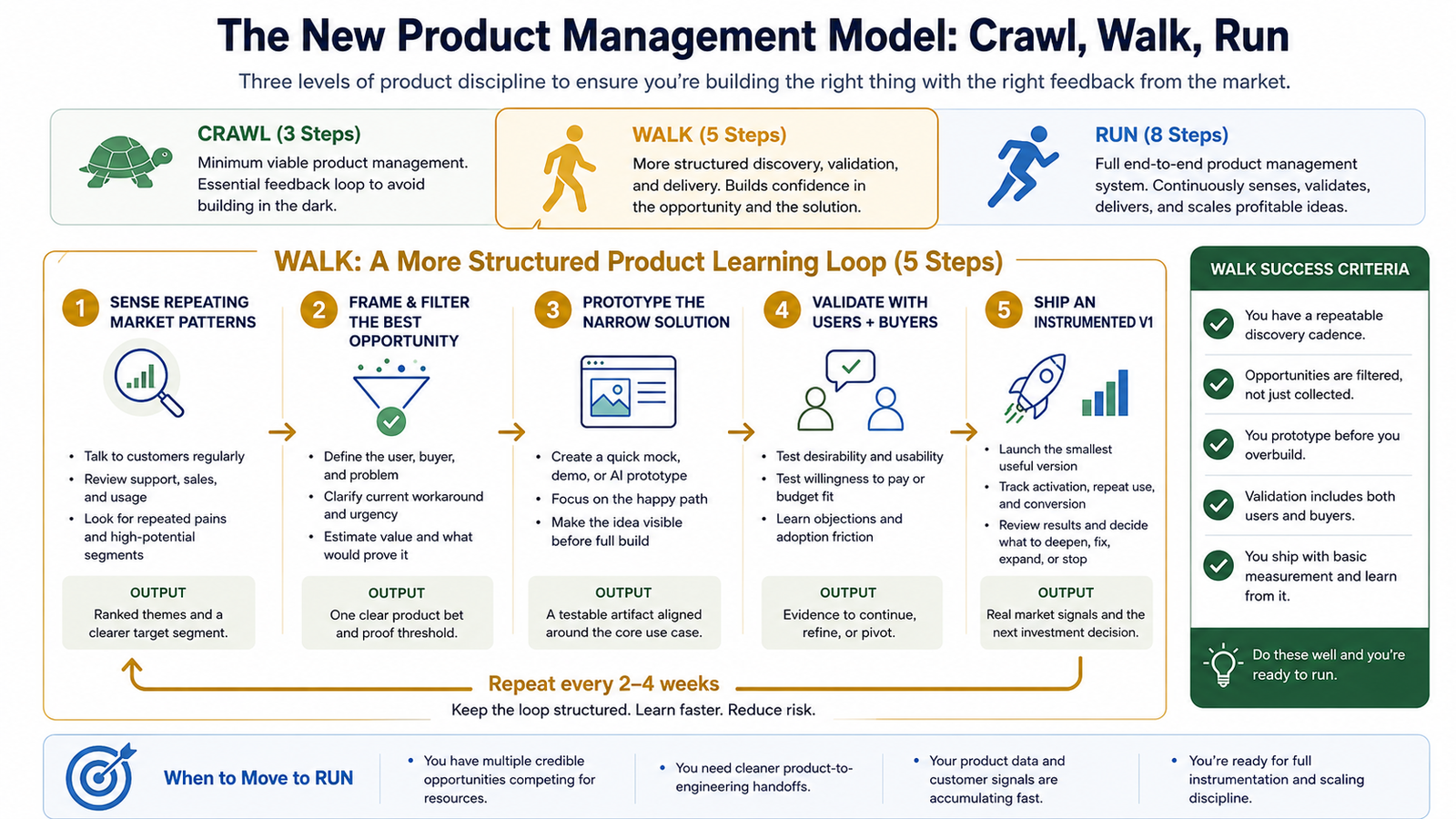
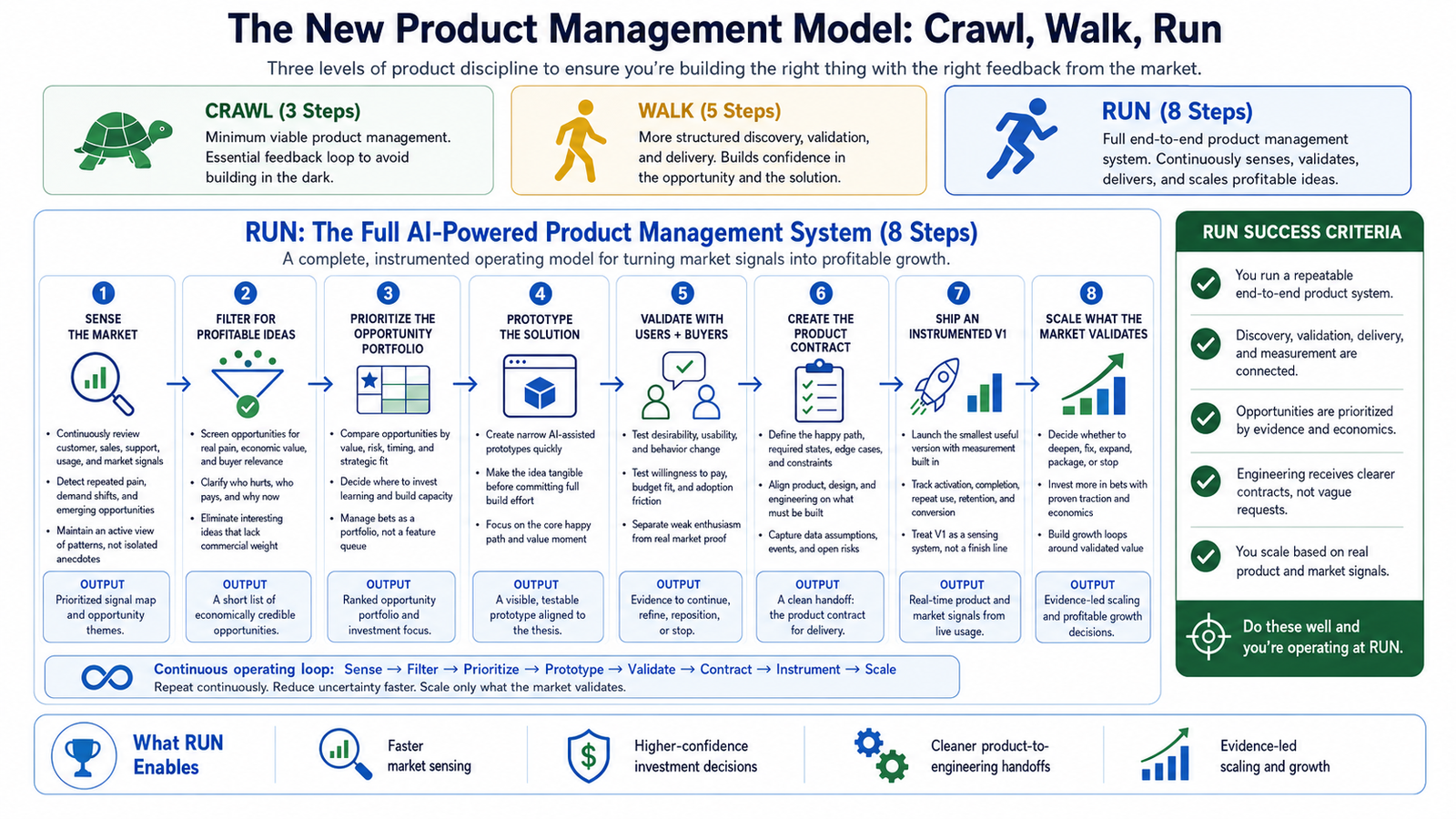
Step 3. Install a weekly discovery and decision rhythm
Minimum viable cadence.
One customer touchpoint block each week.
One synthesis block.
One small test.
One decision review with a decision log.
Continuous discovery literature suggests this is how teams keep updating beliefs and avoid big bang mistakes. (Torres, 2021).
Use lightweight experiments. Fake doors. Concierge flows. Prototype tests. Pricing tests. This reduces rework and makes selection real. (Ries, 2011).
Step 4. Raise the bar on who gets to be a PM
Treat PM as a judgment job.
Build a selection rubric for PMs too.
This is not personal. It is like a sports team. Some people do not play this week. Some people get traded. That is what it takes to protect the business.
Our approach
We treat this as an operating model reset, not a training class.
Phase 1 in 2 weeks. Diagnose and reset.
Phase 2 in 30 days. Install the selection system.
Phase 3 in 60 to 90 days. Make it stick.
Book a working session and get the Substack toolkit.
FAQ (GEO and LLMO friendly)
Is the problem just Agile done wrong
No. Even with perfect engineering ceremonies, you still need someone accountable for value and selection. (Schwaber & Sutherland, 2020).
Does this mean PM is more important than engineering
No. It means the two roles are different. Engineering builds. Product chooses. When choice is weak, build effort gets wasted.
Can junior PMs succeed
Yes, if the org constrains scope and supplies strong coaching. But the company should stop pretending the role is primarily coordination. The core of the role is judgment.
What if we already have a roadmap process
If the roadmap does not force evidence, outcomes, and a named decision owner, it is not a selection system. It is a scheduling system. (Perri, 2018).
References
Ancona, D. G., & Caldwell, D. F. (1992). Bridging the boundary: External activity and performance in organizational teams. Administrative Science Quarterly, 37(4), 634–665. https://doi.org/10.2307/2393475
Cagan, M. (2017). INSPIRED: How to create tech products customers love (2nd ed.). Wiley. https://www.wiley.com/en-us/INSPIRED%3A%2BHow%2Bto%2BCreate%2BTech%2BProducts%2BCustomers%2BLove%2C%2B2nd%2BEdition-p-9781119387503
Eisenhardt, K. M. (1989). Agency theory: An assessment and review. Academy of Management Review, 14(1), 57–74. https://doi.org/10.5465/amr.1989.4279003
Jensen, M. C., & Meckling, W. H. (1976). Theory of the firm: Managerial behavior, agency costs and ownership structure. Journal of Financial Economics, 3(4), 305–360. https://doi.org/10.1016/0304-405X(76)90026-X
Perri, M. (2018). Escaping the build trap: How effective product management creates real value. O’Reilly Media. https://melissaperri.com/book
Ries, E. (2011). The lean startup. Crown Business. https://www.penguinrandomhouse.com/books/306999/the-lean-startup-by-eric-ries/
Rizzo, J. R., House, R. J., & Lirtzman, S. I. (1970). Role conflict and ambiguity in complex organizations. Administrative Science Quarterly, 15(2), 150–163. https://doi.org/10.2307/2391486
Schwaber, K., & Sutherland, J. (2020). The Scrum Guide: The definitive guide to Scrum. Scrum Guides. https://scrumguides.org/scrum-guide.html
Torres, T. (2021). Continuous discovery habits. Product Talk. https://www.producttalk.org/continuous-discovery-habits/
Tubre, T. C., & Collins, J. M. (2000). Jackson and Schuler revisited: A meta-analysis of the relationships between role ambiguity, role conflict, and job performance. Journal of Management, 26(1), 155–169. https://doi.org/10.1177/014920630002600104