Executive summary
In many B2B SaaS companies, “product management” exists in org charts—but not as a profession. The role is under-defined, inconsistently staffed, lightly trained, and evaluated on activity (tickets, roadmaps, shipping) rather than outcomes. Research on software product management (SPM) repeatedly shows the work is broad, cross-functional, and capability-heavy—meaning ambiguity and weak operating norms reliably produce worse performance. For example, SPM challenge studies surface recurring issues like shifting priorities, siloed work, technical debt pressure, and reactive overload. (Springer & Miler, 2022)
If you want product to perform, you can’t treat it as vibes. You professionalize it the same way you professionalize security, finance, or sales: competencies, standards, operating cadence, evidence, and accountability. Capability frameworks (like SFIA) explicitly define product management as lifecycle stewardship with responsibility levels. (SFIA Foundation, 2024) Public-sector role frameworks (like the UK Government’s) define product roles, expected scope, and progression. (UK Government, n.d.) Industry bodies of knowledge (ISPMA, PDMA) codify what “good” looks like. (ISPMA, n.d.) (PDMA, n.d.)
This insight discussion lays out the symptoms, root causes, impacts, and a practical path to build professional product management capability—so PM performance is measurable and improvement is repeatable.
What “no professional PM” looks like (symptoms you can observe)
You likely have no professional product management if most of these are true:
1) Role confusion is structural
- PM ≈ PO ≈ Project Manager ≈ “Roadmap Admin” (varies by team)
- Responsibilities shift with each stakeholder escalation
Research shows PM work spans multiple roles and archetypes in practice—often far beyond the “mini-CEO” cliché. (Maglyas, Nikula, & Smolander, 2013)
2) There is no shared standard of product work
- “Requirements,” “PRD,” “Opportunity,” “Experiment,” and “Roadmap” mean different things per squad
- Artifacts are optional, inconsistent, and rarely reviewed for quality
Requirements engineering standards exist specifically to define required processes and information items for requirements across the lifecycle. (ISO, 2018)
3) Performance management is evasive
- PM evaluation is primarily stakeholder sentiment or shipping volume
- Outcomes are debated after the fact (“Sales says it helped!”)
- Misses don’t change how product decisions get made
4) Training is ad hoc
- No consistent onboarding, no competency baseline, no leveling rubric
- Strong PMs self-teach; weak PMs survive by coordination and charisma
5) Operating cadence is reactive
- Roadmaps churn; priorities change frequently; “urgent” wins
These recurring conditions show up prominently in empirical SPM challenge research. (Springer & Miler, 2022)
Why this happens (root causes)
Root cause 1: Product is treated as a function, not a decision system
In many orgs, “Product” is positioned like a service team (“gather requirements”) rather than the system that governs value, sequence, and evidence. SPM research emphasizes that product management’s central responsibility is ensuring economic success across the product lifecycle—not simply coordinating delivery. (Ebert, 2007)
Root cause 2: You didn’t hire for—or build—SPM capabilities
SPM capability models describe dozens of capabilities a software product organization should implement to reach maturity. (van de Weerd et al., 2010) When those capabilities don’t exist, PMs improvise, and the org starts rewarding improvisation.
Root cause 3: Role ambiguity becomes the default operating condition
Broad organizational evidence shows stressors like role ambiguity are negatively related to performance. (Gilboa et al., 2008) When PM scope is undefined, performance conversations become political.
Root cause 4: No professional ladder means no professional accountability
When you don’t have levels, competencies, and expectations, you can’t diagnose “what good looks like,” and you can’t coach toward it. That’s exactly why competency frameworks like SFIA define skill levels for product management (from assisted execution to strategy leadership). (SFIA Foundation, 2024)
Root cause 5: The job is expanding faster than the organization’s maturity
Recent work mapping product tasks shows high task volume and role variety, including the importance of data in product management work. (Grigoryan et al., 2025) Trends like AI, DevOps, and ecosystems push SPM toward more experimental, hypothesis-driven modes—raising the bar further. (Olsson, 2023)
Business impact (what it costs you)
- Slower learning, not just slower shipping
When product decisions aren’t evidence-driven, teams ship to resolve debate instead of shipping to test value.
- Backlog inflation + roadmap churn
SPM challenges frequently include shifting priorities and reactive/proactive imbalance. (Springer & Miler, 2022)
- Weak product quality signals
If “requirements” and success metrics aren’t disciplined, teams optimize for output.
- Hidden attrition risk
Strong PMs leave when they can’t do the job professionally; weaker PMs stay because the system doesn’t measure improvement.
- AI makes this worse, not better
Generative AI can increase productivity for less-experienced workers in certain contexts, but that does not replace product judgment; it raises the premium on clear decision rights and evaluation. (Brynjolfsson, Li, & Raymond, 2023)
What good looks like (professional PM as an organizational capability)
Professional product management is not “more process.” It’s a repeatable decision system:
1) Clear role definitions + progression
Use an explicit role framework that defines scope and expectations (e.g., product manager vs senior product manager). (UK Government, n.d.)
2) Competencies and leveling tied to outcomes
Adopt a competency model (SFIA-style) so managers can coach and assess consistently. (SFIA Foundation, 2024)
3) A Body of Knowledge + shared vocabulary
Codify the discipline (e.g., ISPMA BoK for software; PDMA BoK for product innovation). (ISPMA, n.d.) (PDMA, n.d.)
4) Standard artifacts with quality gates
Requirements engineering provides defined processes and information items; your product system should specify “what must be true” before commitments. (ISO, 2018)
5) Measurable product performance
High-performance product management research links structure, process, competencies, and role definition to product management performance. (Tyagi & Sawhney, 2010)
6) Maturity improvement is intentional
SPM maturity work provides assessment and improvement models; evaluation studies show how maturity matrices can be validated and improved using case evidence. (Bekkers et al., 2012) (Bekkers et al., 2010)
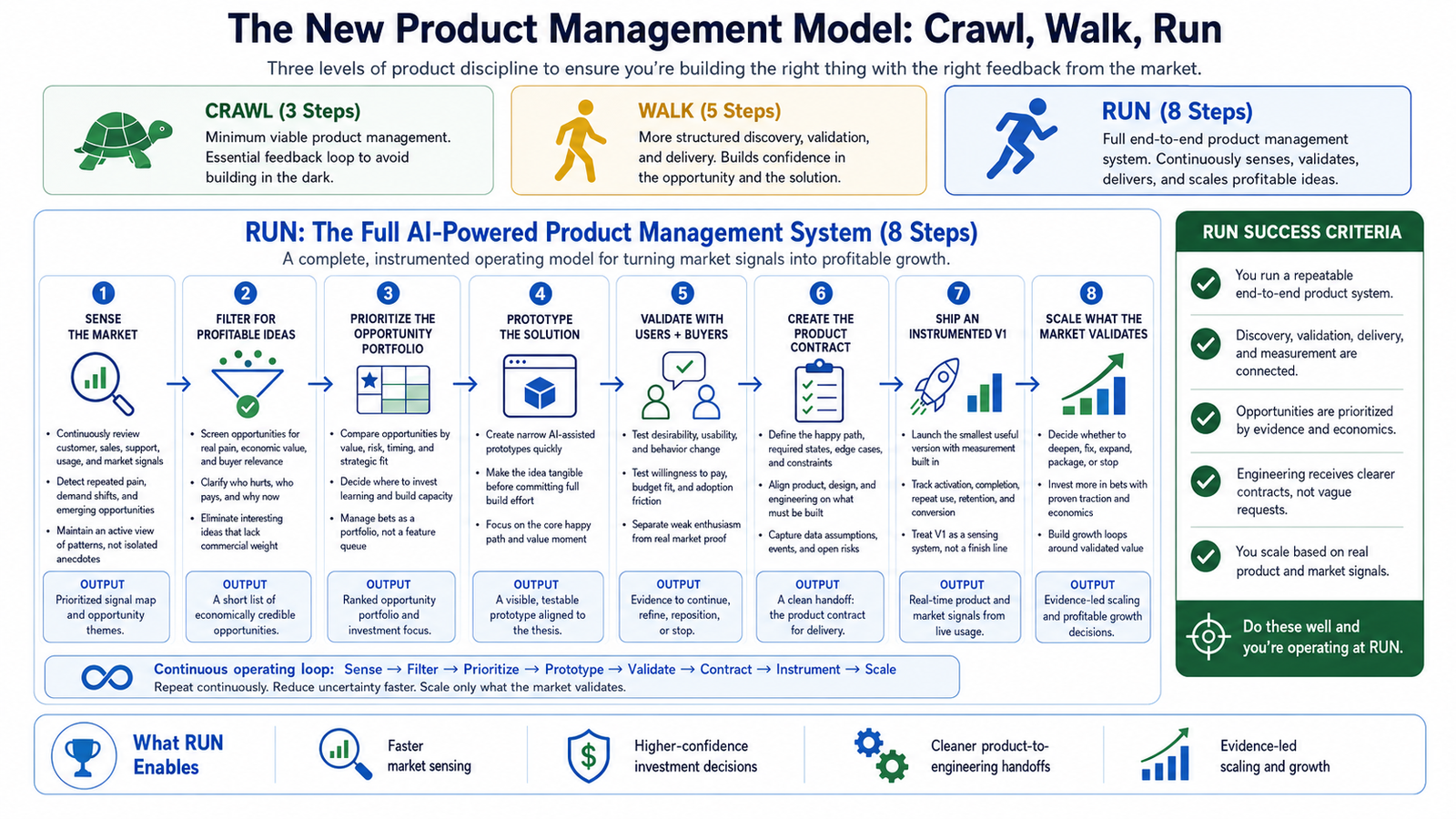
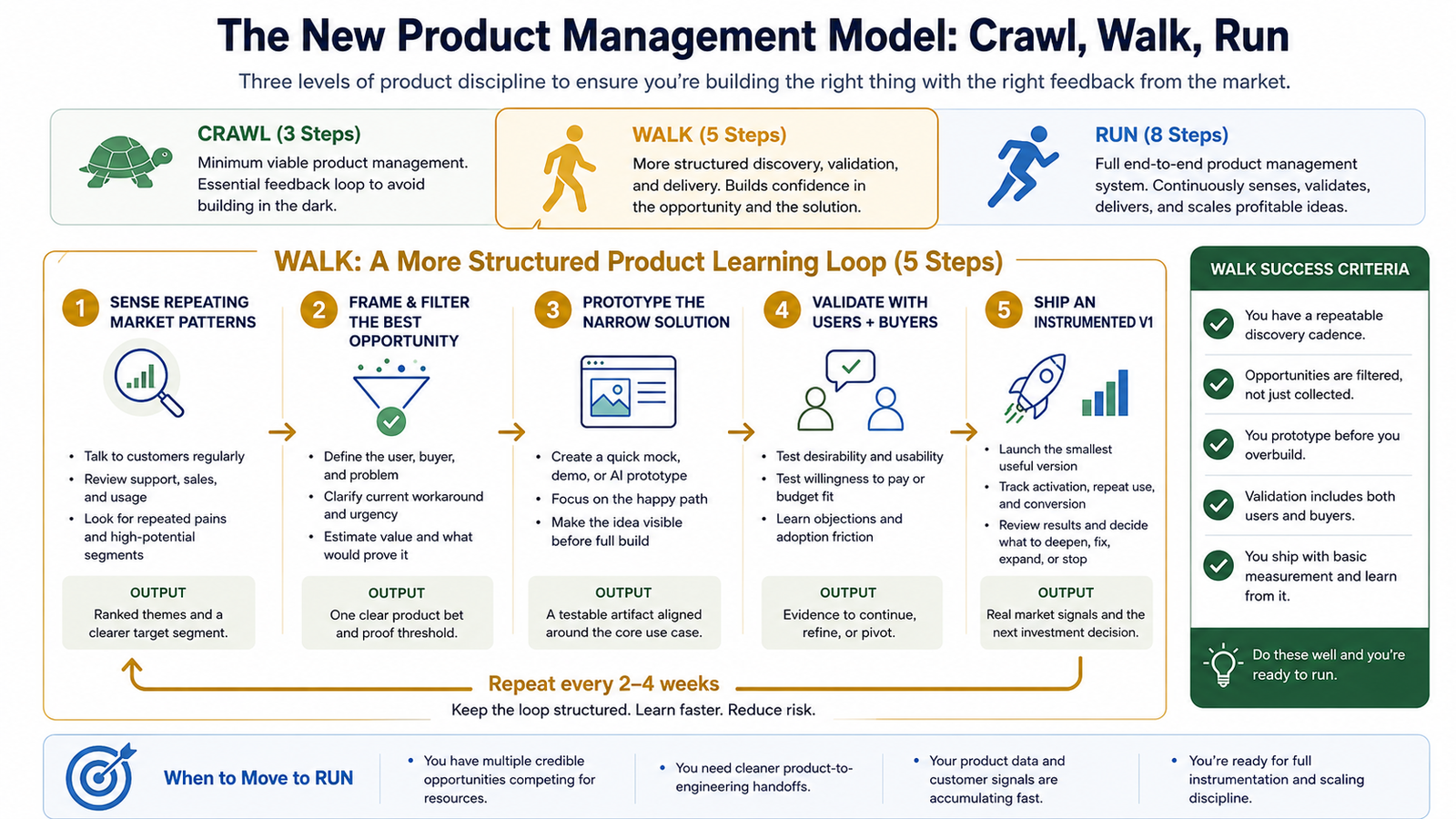
The DrCPO Solution: Professional Product Management Capability (PPMC)
This is the system I implement with CEOs/CPOs/CTOs when “product” exists but professional product management does not.
Component 1: Decision rights + operating cadence
- Product strategy and “what we will not do”
- Portfolio and sequencing governance
- A standard cadence for discovery-to-commitment decisions
Component 2: Competency model + leveling + coaching loops
- A role ladder aligned to your business (and benchmarked to public frameworks)
- Skills assessment and coaching plan per PM
Component 3: Standard product artifacts + quality gates
- A minimal artifact set (lean but mandatory)
- Review gates before roadmap commitments
Component 4: Performance measurement that survives debate
- A small number of outcome metrics per product
- A “decision log” linking bets → evidence → outcomes
Component 5: Maturity assessment and targeted upgrades
30–60–90 day plan (practical, not theoretical)
Days 0–30: Make the invisible visible
- Map current PM responsibilities vs what the business needs
- Establish interim decision rights (who decides sequencing, pricing, packaging, etc.)
- Baseline artifact quality and roadmap churn drivers
Grounded studies show PM roles often emerge as connector roles as orgs grow—so you need to formalize before growth hardens chaos. (Melegati et al., 2024)
Days 31–60: Install the professional backbone
- Publish product role definitions and leveling rubric
- Adopt a competency baseline and begin skills assessments
- Implement minimum quality gates for product commitments
Research on core SPM activities helps separate “core” vs “supporting” work so PMs stop drowning in coordination. (Maglyas et al., 2017)
Days 61–90: Tie product performance to outcomes
- Define product outcome metrics per surface area
- Implement decision logs and quarterly product reviews
- Launch coaching plans and hiring profile updates
Empirical studies highlight the importance of well-defined product management for product success—your system should operationalize that link. (Ebert, 2007)
Examples (anonymized patterns)
- Series B SaaS: “Roadmap = sales escalations”
After establishing decision rights, artifact gates, and a single outcomes dashboard per product, roadmap churn fell because escalation had to meet an evidence bar (not volume).
- Mid-market platform: PMs as “mini-project managers”
A competency baseline + core/supporting activity split reduced PM time spent on coordination and increased time on discovery and portfolio reasoning (measured via calendar + artifact review).
- Enterprise SaaS: AI features everywhere, strategy nowhere
Adding an experimentation standard and decision log prevented “AI theater” and forced hypothesis clarity—critical as SPM practices shift under AI and data pressures. (Olsson, 2023) (Grigoryan et al., 2025)
Call to action
If this describes your org, let’s fix it the right way to create competitive advantage: professionalize product management as a capability.
Book a working session today.
You’ll can also get access to my Substack toolkit.
FAQ
Isn’t product management inherently different everywhere?
Yes—context matters. That’s why you anchor on a BoK + competency framework, then tailor role definitions to your strategy and constraints. (ISPMA, n.d.) (SFIA Foundation, 2024)
Will this slow teams down?
It reduces unproductive debate and rework by making decisions explicit and evidence-driven.
Do we need certification?
Not necessarily—but bodies of knowledge and certification curricula can be useful scaffolding for consistency and hiring signals. (PDMA, n.d.) (ISPMA, n.d.)
References
- Bekkers, W., Brinkkemper, S., van den Bemd, L., Mijnhardt, F., Wagner, C., & van de Weerd, I. (2012). Evaluating the Software Product Management Maturity Matrix. IEEE Requirements Engineering Conference (RE). https://dl.acm.org/doi/10.1109/RE.2012.6345839
- Bekkers, W., van de Weerd, I., Spruit, M., & Brinkkemper, S. (2010). A framework for process improvement in software product management. In EuroSPI 2010 (CCIS). Springer. https://link.springer.com/chapter/10.1007/978-3-642-15666-3_1
- Brynjolfsson, E., Li, D., & Raymond, L. R. (2023). Generative AI at Work (NBER Working Paper No. 31161). National Bureau of Economic Research. https://www.nber.org/papers/w31161
- Ebert, C. (2007). The impacts of software product management. Journal of Systems and Software, 80(6), 850–861. https://www.sciencedirect.com/science/article/pii/S0164121206002615
- Gilboa, S., Shirom, A., Fried, Y., & Cooper, C. (2008). A meta-analysis of work demand stressors and job performance. Personnel Psychology, 61(2), 227–271. https://onlinelibrary.wiley.com/doi/10.1111/j.1744-6570.2008.00113.x
- Grigoryan, K., Martin, L., Lamarz, J., Fichtler, T., Hohn, B., Asmar, L., Kühn, A., & Dumitrescu, R. (2025). Product management: Tasks, roles, and the importance of data. Procedia CIRP, 136, 838–843. https://www.sciencedirect.com/science/article/pii/S2212827125008960
- ISO. (2018). ISO/IEC/IEEE 29148:2018 — Requirements engineering. https://www.iso.org/standard/72089.html
- ISPMA. (n.d.). Software Product Management Body of Knowledge (BoK). https://ispma.org/bok/
- Maglyas, A., Nikula, U., Smolander, K., & Fricker, S. (2017). Core software product management activities. Journal of Advances in Management Research, 14(1), 23–45. https://www.emerald.com/jamr/article/14/1/23/207161/Core-software-product-management-activities
- Maglyas, A., Nikula, U., & Smolander, K. (2013). What are the roles of software product managers? An empirical investigation. Journal of Systems and Software, 86(12), 3071–3090. https://www.sciencedirect.com/science/article/pii/S0164121213001891
- Melegati, J., Gonçalves, J. A. M., Visaggio, C. A., & Krusche, S. (2024). Product managers in software startups: A grounded theory. Information and Software Technology. https://www.sciencedirect.com/science/article/pii/S0950584924001216
- Olsson, H. H. (2023). Strategic digital product management in the age of AI. In Lecture Notes in Business Information Processing. Springer. https://link.springer.com/chapter/10.1007/978-3-031-53227-6_24
- PDMA. (n.d.). NPDP Body of Knowledge (2nd ed.). https://www.pdma.org/page/npdp-bok-second-edition
- SFIA Foundation. (2024). SFIA 9 skill: Product management (PROD). https://sfia-online.org/en/sfia-9/skills/product-management
- Springer, O., & Miler, J. (2022). A comprehensive overview of software product management challenges. Empirical Software Engineering, 27, 106. https://doi.org/10.1007/s10664-022-10134-5
- Tyagi, R. K., & Sawhney, M. S. (2010). High-performance product management: The impact of structure, process, competencies, and role definition. Journal of Product Innovation Management, 27(1), 83–96. https://onlinelibrary.wiley.com/doi/10.1111/j.1540-5885.2009.00701.x
- UK Government (GDS). (n.d.). Government Digital and Data Capability Framework: Product manager. https://ddat-capability-framework.service.gov.uk/role/product-manager
- van de Weerd, I., Bekkers, W., Brinkkemper, S., & Nieuwenhuis, R. (2010). Developing a maturity matrix for software product management. In ICSOB 2010. Springer. https://link.springer.com/chapter/10.1007/978-3-642-13633-7_7