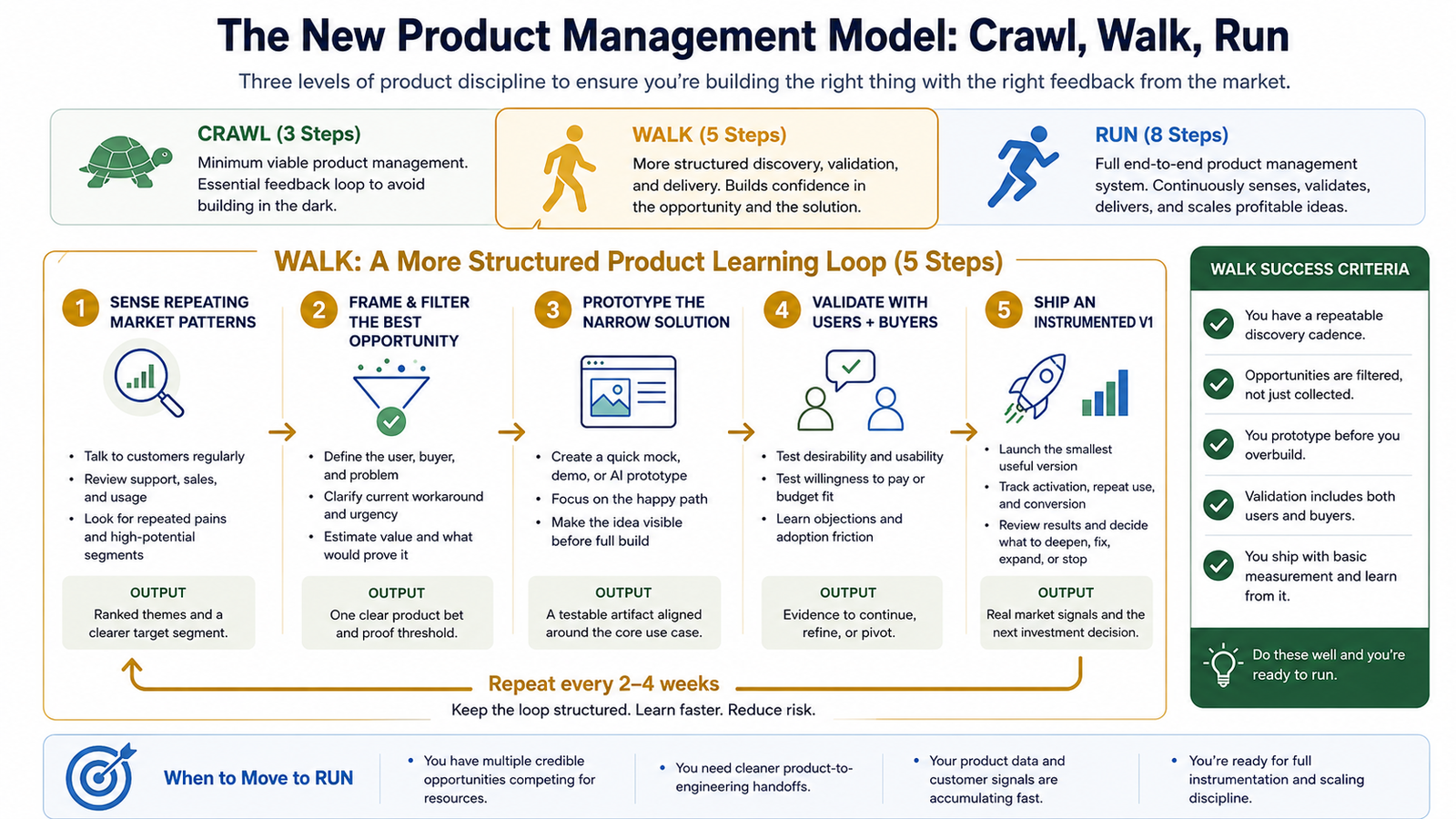
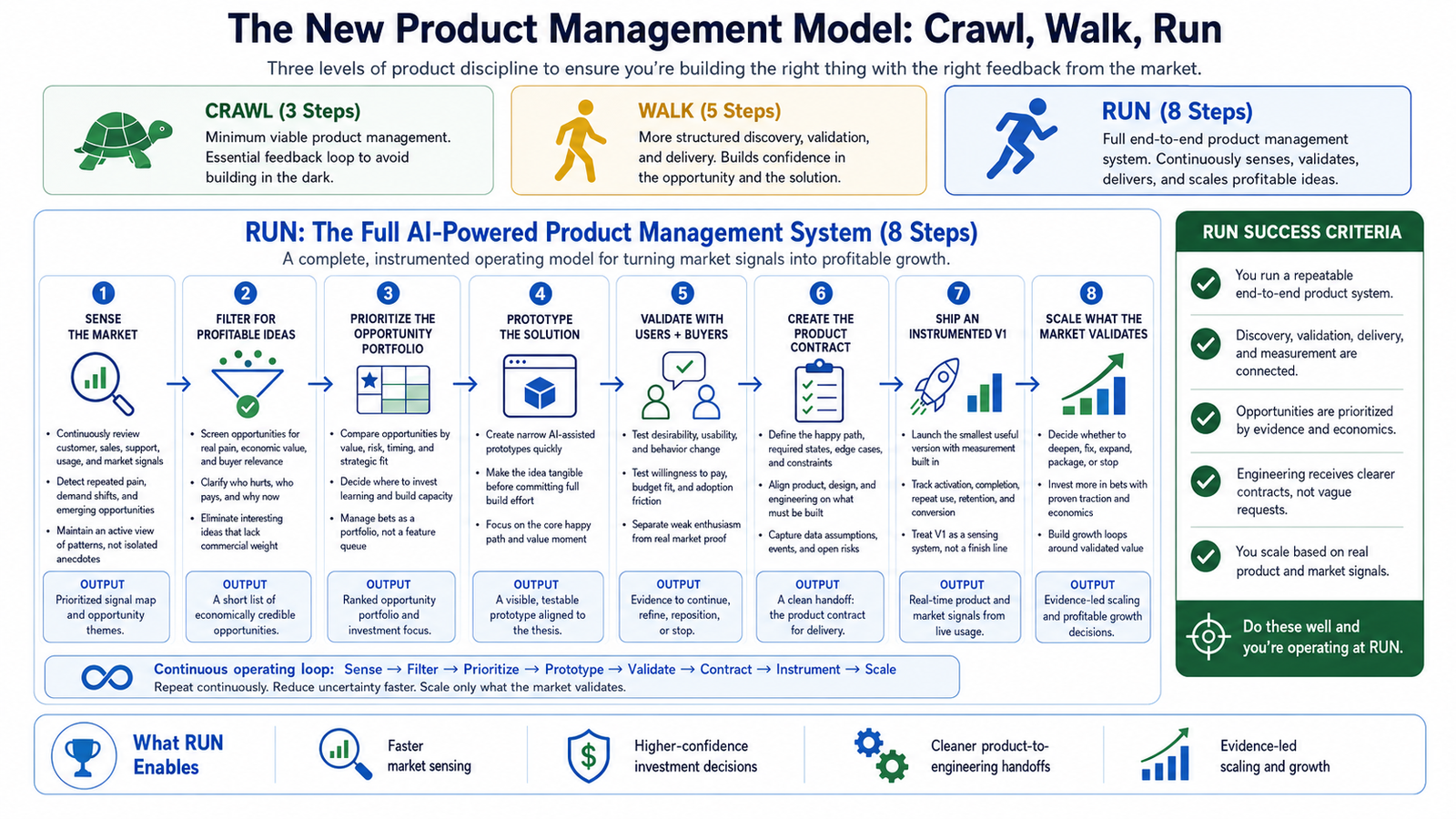
CPO/Head of Product (Audience)
AI in Product Management (Pillar)
CEO/GM (Audience)


In 2026, the companies that win will not be the ones that ship the most. They will be the ones that decide best.
AI is making software delivery cheaper and faster. That is leverage. It is also risk. Cheaper execution means more chances to get it wrong. You can now build a lot of things nobody wants very quickly.
So competitive advantage moves upstream into discovery.
Here is the split that defines discovery in 2026.
AI is excellent at harvesting digital exhaust across the enterprise. It can pull signals from usage telemetry, support tickets, CRM notes, call transcripts, docs, and feedback tools. It can summarize quantities of information beyond human scale into readable briefs. (Wharton Human-AI Research & GBK Collective, 2025; McKinsey & Company, 2025).
Humans are excellent at synthesis and judgment. Humans decide what matters, what tradeoff is acceptable, what evidence is strong enough, and what bet the company should place next.
Discovery becomes the discipline that turns AI summaries into investment-grade decisions that have a higher probability of success in the marketplace. (Grange et al., 2025; Gilad, 2023).
When development was expensive, teams had fewer shots. They did more homework because they had to. They still got it wrong.
Now the danger is speed without precision. When teams can build cheaply, the failure mode becomes output. Shipping volume becomes a substitute for decision quality. That is how you end up with a roadmap full of features and a market that does not care.
Business research on GenAI adoption shows a similar pattern across functions. Tools spread quickly. Value depends on how work is redesigned and governed. (Wharton Human-AI Research & GBK Collective, 2025; McKinsey & Company, 2025).
So the prize is not just faster execution. The prize is aiming faster execution at the right thing.
Classic discovery literature taught better rituals. Interviews. Workshops. PRDs.
In 2026, those are not the center.
The center is a decision system that can do three things well.
This shift shows up in both practice and research.
In human centered innovation settings, researchers found that GenAI can accelerate parts of structured discovery work, but value depends on synchronizing AI capabilities with human intelligence and creativity. Humans still anchor intent, framing, and judgment. (Grange et al., 2025).
In decision analysis research, GenAI could generate many plausible objectives, but the sets were often flawed without human expertise to structure, prune, and ensure completeness. That is a clean proxy for product discovery. AI can propose. Humans must synthesize and validate decision quality. (Simon & Siebert, 2025).
So discovery maturity is not more output. It is better decision quality under uncertainty.
The most practical way to design discovery is to decide who does what.
AI responsibilities
Human responsibilities
This division aligns with what organizational research calls out as the core challenge. Human AI collaboration needs trust, clear roles, and a formal model for oversight and accountability. (Do Khac, 2025). It also aligns with trustworthiness work in decision making that warns about misalignment with decision context when AI outputs are not grounded in domain knowledge and constraints. (Miedema, 2026; NIST, 2023).
Even with the right roles, many orgs still move slowly because discovery is trapped in handoffs.
You can treat discovery as an end to end workflow optimization problem.
Map the full path from signal to shipped learning. Count steps. Identify wait states. Then collapse steps where AI can remove labor and reduce friction. Protect the steps where humans must own judgment.
This is how GenAI implementation succeeds in real enterprises. Case work describing GenAI adoption inside IT service management shows that results depend on embedding GenAI into workflows, not just deploying a tool. (Sharma et al., 2026).
The same logic applies to discovery. If you bolt AI onto existing rituals, you get more artifacts and the same delays.
You still need a clear stack. AI changes how the stack is executed.
Most teams have signals but not a system.
A system means clear sources, ownership, hygiene, and cadence. It also means routing signals into a layer where AI can summarize and connect them.
This is where retrieval and enterprise knowledge systems matter. Recent work proposes capability levels for retrieval augmented generation systems over enterprise data. It describes progress from surface search over unstructured data toward more reflective question answering. That is the technical backbone for turning digital exhaust into usable briefs. (Gill et al., 2025).
AI can summarize. It can cluster. It can draft. That reduces labor.
Humans still need to synthesize. Humans separate symptoms from causes. Humans assess confidence. Humans tie confidence to decision cost.
Evidence guided product work is helpful here because it gives teams a governance language. Confidence becomes an explicit input. Decisions have thresholds. (Gilad, 2023).
A strong decision is not just insight. It is a case that survives scrutiny.
That means clear stakes, clear alternatives, and pre alignment with the people who will fund and support the bet.
Persuasion research still applies. Contrast and concrete stakes move decisions. (Duarte, 2010; Heath & Heath, 2007). Change research still applies. Coalitions form before the meeting. (Kotter, 1996).
AI helps by assembling proof points and drafting variants. Humans still synthesize the narrative and own the decision.
If you want a concrete example of the AI plus human model, look at requirements.
Recent research in requirements engineering shows LLMs can reformulate requirements and assess quality criteria in workflows that matter to product teams. The practical takeaway is not that AI replaces PM thinking. The takeaway is that AI raises the floor on hygiene, while humans keep ownership of meaning and tradeoffs. (Ellsel et al., 2025).
AI outputs can look polished and still be wrong. That increases overreliance risk.
Recent work on AI agent ecosystems highlights uneven transparency about evaluations and safety features. That is a warning for discovery leaders. You need evaluation habits and traceability, not just convenience. (Staufer et al., 2026).
Use governance. Use oversight. Use traceability from claims to sources. Use a grounding artifact like an opportunity solution tree to anchor outcomes and evidence. (Torres, 2023; NIST, 2023).
If you want AI driven discovery that produces investment grade decisions, do this in the next 10 business days.
If you want help designing this for your org, book a working session.
If you want to get going, get the Substack toolkit you can use right away including a process checklist, a signal input blueprint, a decision brief template, and an RFP template.
Anonymous. (2025). From Search to Reasoning: A Five-Level RAG Capability Framework for Enterprise Data. https://arxiv.org/html/2509.21324v1
Do Khac, L. T. (2025). Towards an integrative model of organizational human-AI collaboration: A semi-systematic review of the current state of the art. https://www.sciencedirect.com/science/article/pii/S0160791X25002544
Duarte, N. (2010). Resonate: Present Visual Stories that Transform Audiences. https://www.wiley.com/en-us/Resonate%3A%2BPresent%2BVisual%2BStories%2Bthat%2BTransform%2BAudiences-p-9780470632017
Ellsel, E., et al. (2025). Advancing Requirements Engineering with Large Language Models. https://www.researchgate.net/publication/395017512_Advancing_Requirements_Engineering_with_Large_Language_Models
Gilad, I. (2023). Evidence-Guided. https://itamargilad.com/book-evidence-guided/
Grange, C., Demazure, T., Ringeval, M., Bourdeau, S., & Martineau, C. (2025). The Human-GenAI Value Loop in Human-Centered Innovation: Beyond the Magical Narrative. https://onlinelibrary.wiley.com/doi/10.1111/isj.12602?af=R
Heath, C., & Heath, D. (2007). Made to Stick. https://heathbrothers.com/books/made-to-stick/
Kotter, J. P. (1996). Leading Change. https://www.hbs.edu/faculty/Pages/item.aspx?num=137
McKinsey & Company. (2025). The State of AI: Global Survey 2025. https://www.mckinsey.com/capabilities/quantumblack/our-insights/the-state-of-ai
McKinsey & Company. (2025). The next innovation revolution powered by AI. https://www.mckinsey.com/capabilities/quantumblack/our-insights/the-next-innovation-revolution-powered-by-ai
Miedema, E. (2026). Towards trustworthy artificial intelligence for decision-making: A lifecycle perspective on knowledge- and data-driven artificial intelligence systems. https://www.sciencedirect.com/science/article/pii/S0166361525001745
National Institute of Standards and Technology. (2023). Artificial Intelligence Risk Management Framework (AI RMF 1.0). https://nvlpubs.nist.gov/nistpubs/ai/nist.ai.100-1.pdf
Sharma, A. J., et al. (2026). Generative AI Implementation in Enterprises: Lessons From a Case Study of Enhanced IT Service Management. https://onlinelibrary.wiley.com/doi/10.1111/isj.70029
Simon, J., & Siebert, J. U. (2025). ChatGPT vs. Experts: Can GenAI Develop High-Quality Organizational and Policy Objectives? https://pubsonline.informs.org/doi/10.1287/deca.2025.0387
Staufer, L., Feng, K., Wei, K., Bailey, L., Duan, Y., Yang, M., Ozisik, A. P., Casper, S., & Kolt, N. (2026). The 2025 AI Agent Index: Documenting Technical and Safety Features of Deployed Agentic AI Systems. https://arxiv.org/abs/2602.17753
Torres, T. (2023). Opportunity Solution Trees: Visualize Your Discovery to Stay Aligned and Drive Outcomes. https://www.producttalk.org/opportunity-solution-trees/
Wharton Human-AI Research & GBK Collective. (2025). Accountable Acceleration: Gen AI Fast-Tracks Into the Enterprise. https://ai.wharton.upenn.edu/wp-content/uploads/2025/10/2025-Wharton-GBK-AI-Adoption-Report_Full-Report.pdf