CPO/Head of Product (Audience)
AI in Product Management (Pillar)
CEO/GM (Audience)

For decades, product management operated inside a familiar chain.
Customers had problems. Researchers gathered insights. Product managers translated those insights into requirements. Designers translated requirements into mocks. Engineers translated mocks into software. Then the market delivered its verdict through adoption, revenue, churn, or indifference.
That model made sense when software was expensive, slow, and difficult to build. In that world, the product manager’s central job was often translation. Translate the customer problem. Translate the stakeholder request. Translate the roadmap. Translate the requirement into something design and engineering could act on.
AI changes the economics of that work.
When prototypes can be created from prompts, when software scaffolds can be generated quickly, when research synthesis can happen across thousands of signals instead of dozens, and when product teams can test visible artifacts earlier, the bottleneck moves. The hardest part is no longer producing more output. The hardest part is deciding what deserves to exist.
That is the shift behind the new AI-powered product management model.
The new PM operating question is no longer simply: “What should we build?”
It is: “Which market opening is valuable enough, urgent enough, adoptable enough, and economically attractive enough to deserve investment?”
That is a much higher bar.
In short
Book a working session if you want help working out which stage your team is at.
The old product process often began with a collection of inputs: customer complaints, sales asks, executive priorities, competitive pressure, usage data, research findings, and roadmap commitments.
The PM’s job was to organize those inputs into a coherent plan. Good PMs brought clarity. They wrote requirements, aligned teams, negotiated tradeoffs, clarified priorities, and helped engineering deliver.
That work still matters. Teams still need clarity. Engineering still needs strong problem definition. Design still needs context. Leaders still need tradeoff recommendations.
The difference is that AI reduces the cost of creating plausible product output. It becomes easier to produce documents, mocks, prototypes, analysis, code, copy, experiments, and launch materials. The volume of possible product work expands dramatically. In a small McKinsey study of 40 product managers, generative AI improved PM productivity by 40 percent (Gnanasambandam et al., 2024).
That creates a new problem.
When output gets cheaper, bad decisions get more expensive.
A team can now move faster in the wrong direction. It can create beautiful prototypes for weak ideas. It can generate detailed requirements for problems nobody will pay to solve. It can produce more roadmap motion without creating more enterprise value. Output is not the same as outcomes (Perri, 2018).
So the new PM must become much sharper at the front end of product work. The PM must separate interesting ideas from profitable ideas. They must connect user pain, buyer urgency, market timing, adoption friction, technical feasibility, and economic value earlier in the process.
The new product management model is built around one central idea:
The PM becomes the executive function for profitable ideas.
That does not mean the PM replaces design, engineering, research, sales, marketing, or finance. It means the PM becomes the person most responsible for connecting those perspectives into a disciplined product investment thesis.
A profitable idea is more than a pain point. It is more than a feature request. It is more than a clever workflow improvement.
A profitable idea clears five tests:
Those tests extend the classic product risks of value, usability, feasibility and business viability (Cagan, 2017).
That is where AI becomes powerful. AI can help widen the search surface, synthesize more evidence, generate alternatives, simulate scenarios, draft prototypes, and accelerate learning. The human product leader still provides judgment. The human product leader still decides what matters, what is credible, what is risky, and what evidence is strong enough to justify the next investment.
The point is to use AI to reduce uncertainty faster.
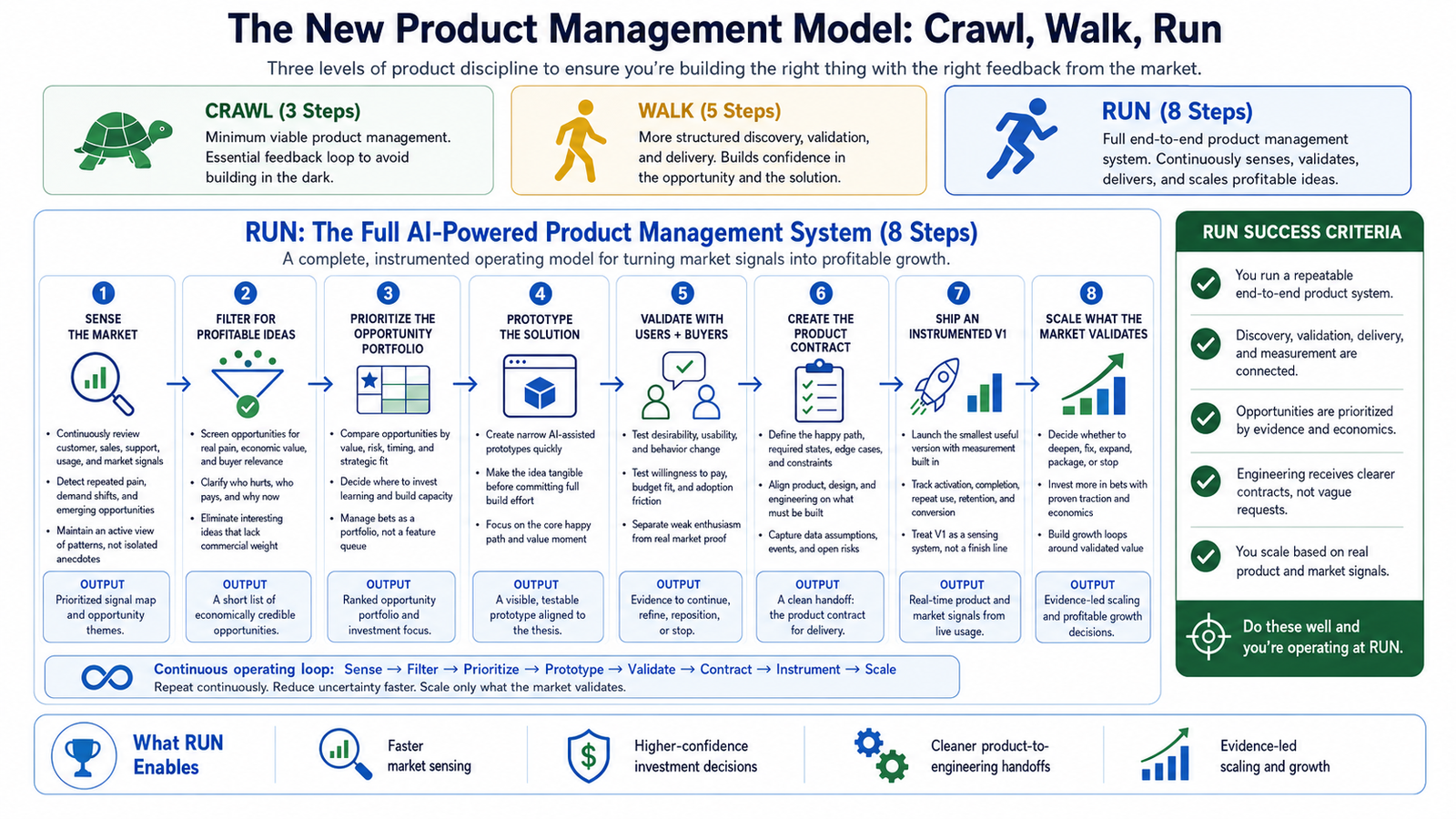
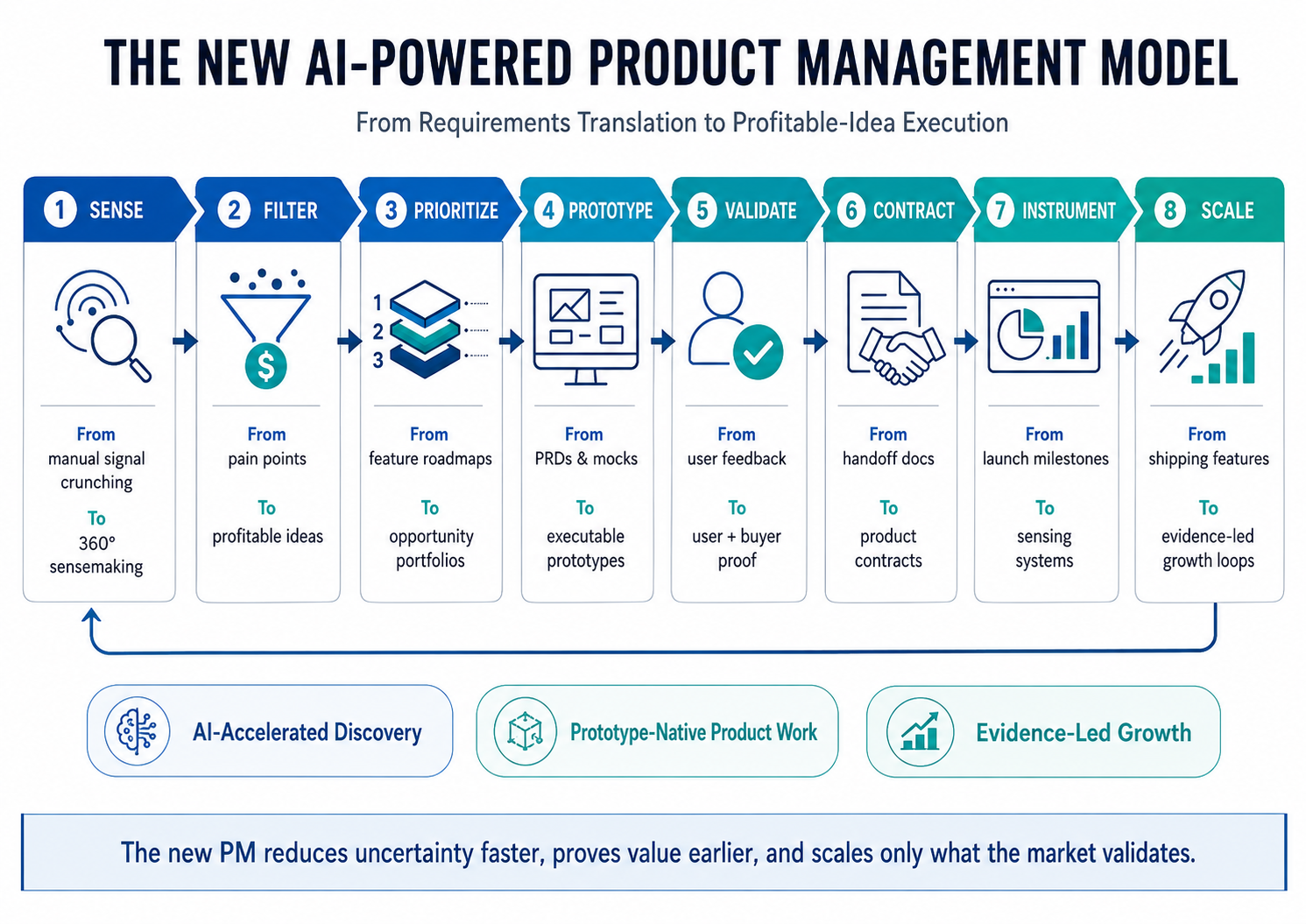
The new AI-powered product management model has eight steps:
Sense → Filter → Prioritize → Prototype → Validate → Contract → Instrument → Scale
Each step represents a shift from the old product operating pattern to a new one.
Product discovery used to be constrained by human bandwidth. A team could interview customers, review support tickets, look at product analytics, talk to sales, scan competitors, and maybe review market research. Each input was useful, but the synthesis was slow and partial.
AI allows product teams to sense across a much wider field.
The new PM can look across customer interviews, support themes, sales calls, win/loss notes, product analytics, search behavior, reviews, community threads, analyst reports, usage data, and competitive moves. The work becomes less about collecting a few signals and more about building a living map of market friction, refreshed every week rather than once a quarter (Torres, 2021).
The question becomes: “Where is pain accumulating, and where might that pain become economically meaningful?”
More on this split between AI gathering and humans deciding: How AI Is Transforming Product Discovery.
Many product teams have too many ideas. They do not have too many profitable ideas.
The new PM needs a sharper economic filter. A pain point deserves attention when it creates measurable cost, missed revenue, operational drag, churn risk, compliance exposure, slower throughput, or strategic disadvantage.
The PM must ask earlier: Who owns this pain? Who pays to remove it? What budget would this replace? What metric would prove value? What would make switching worth the trouble?
This step turns discovery from a listening exercise into an investment screen. It is also why the PM must own problem selection.
Traditional prioritization often compares features. Which feature is most requested? Which one serves the biggest customer? Which one supports the quarter’s roadmap? Which one is easiest to build?
The new PM manages an opportunity portfolio.
Each opportunity has assumptions, evidence, risk, expected value, confidence level, and a next learning action (Gilad, 2023). Some opportunities need more customer evidence. Some need buyer testing. Some need prototype validation. Some need technical feasibility work. Some should be killed quickly.
This shifts prioritization from roadmap politics to staged investment logic.
The prototype is becoming one of the most important product artifacts.
A written requirement can describe a workflow. A mock can show a possible interface. A prototype can let a user, buyer, executive, designer, or engineer react to actual behavior.
AI makes this practical much earlier. PMs can now shape narrow happy-path prototypes that make an idea visible. The goal is disciplined learning. The team wants to see whether the idea makes sense when it becomes tangible.
A prototype should answer questions faster than a document can.
Traditional validation often asks whether users like an idea. That is useful, and it is incomplete.
The new validation process must include the buyer. In many B2B and enterprise settings, the user feels the pain, while someone else owns the budget, risk, or business outcome.
So the PM needs to validate both sides.
Does the user experience the pain often enough? Does the prototype change behavior? Does the buyer recognize the economic value? Would this replace budget, reduce cost, increase revenue, reduce risk, or improve throughput? What price would make sense? What switching friction would block adoption?
A product idea becomes stronger when user evidence and buyer evidence point in the same direction. And evidence means behavior and commitment, not compliments (Fitzpatrick, 2013).
The old handoff often relied on documents, meetings, tickets, and mocks. The new handoff needs to preserve intent across a faster, more executable system.
That means the PM-to-engineering interface becomes a product contract.
The contract should include the value thesis, target user, buyer logic, happy path, required states, edge cases, data assumptions, analytics events, accessibility expectations, approved components, technical unknowns, and proof already collected.
Engineering should receive more than a request. Engineering should receive a clear bet that has earned the right to be hardened.
Launch used to be treated as a finish line. The team shipped the thing, announced the thing, and moved on to the next thing.
In the new model, launch is a sensing system.
The first release should be instrumented from the start. The PM should know what activation means, where the value moment occurs, what drop-off would signal confusion, what repeat behavior would signal usefulness, what conversion would signal buyer interest, and what retention would signal durable value (Croll & Yoskovitz, 2013).
The first release is an experiment with a market-facing surface.
The final step is scaling only what the market validates.
The old roadmap often created momentum. Once a feature shipped, the team added enhancements, handled requests, fixed gaps, and kept moving.
The new model requires a more disciplined decision.
Should we deepen this? Fix it? Expand it? Package it? Price it differently? Reposition it? Integrate it elsewhere? Stop investing?
Scaling becomes evidence-led. The PM looks for proof that the opportunity deserves more capital, more engineering, more go-to-market support, and more organizational attention (Ries, 2011).
The new AI-powered product management model is not about using AI to create more product artifacts. It is about using AI to make product judgment faster, broader, and more economically grounded.
The PM still needs empathy. The PM still needs taste. The PM still needs strategic judgment. The PM still needs cross-functional leadership.
Now the PM also needs stronger economic reasoning, sharper signal synthesis, prototype fluency, buyer validation discipline, and instrumentation thinking.
The new PM reduces uncertainty faster, proves value earlier, and scales only what the market validates.
That is the core of the new model.
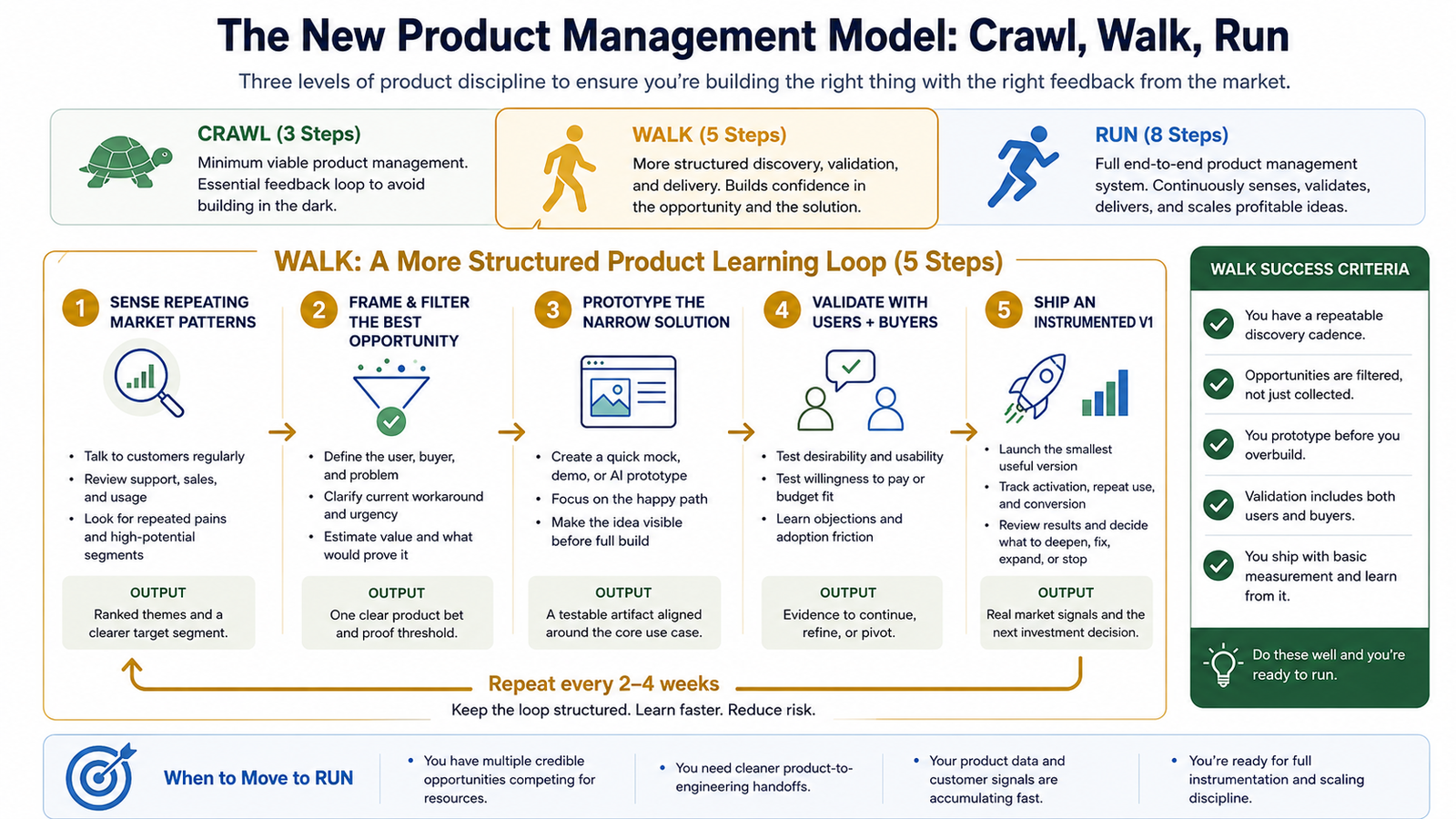
Not every company should run all eight steps on day one. The model has three levels, matched to the stage you are in:
Coming next, a deep dive on each of the eight shifts:
Together, they describe a new product management process for the AI era.
Product management is moving from requirements translation to profitable-idea execution.
And that changes almost everything.
Want help applying the model? Book a working session.
Cagan, M. (2017). The four big risks. Silicon Valley Product Group. https://www.svpg.com/four-big-risks/
Croll, A., & Yoskovitz, B. (2013). Lean analytics: Use data to build a better startup faster. O’Reilly Media. https://www.oreilly.com/library/view/lean-analytics/9781449335687/
Fitzpatrick, R. (2013). The mom test: How to talk to customers and learn if your business is a good idea when everyone is lying to you. https://www.momtestbook.com/
Gilad, I. (2023). Evidence-guided: Creating high-impact products in the face of uncertainty. https://itamargilad.com/book-evidence-guided/
Gnanasambandam, C., Harrysson, M., Singh, R., & Yarlagadda, C. (2024, May 31). How generative AI could accelerate software product time to market. McKinsey & Company. https://www.mckinsey.com/industries/technology-media-and-telecommunications/our-insights/how-generative-ai-could-accelerate-software-product-time-to-market
Perri, M. (2018). Escaping the build trap: How effective product management creates real value. O’Reilly Media. https://melissaperri.com/book
Ries, E. (2011). The lean startup. Crown Business. https://www.penguinrandomhouse.com/books/306999/the-lean-startup-by-eric-ries/
Torres, T. (2021). Continuous discovery habits. Product Talk. https://www.producttalk.org/continuous-discovery-habits/
The New Product Management Model series