Crawl keeps an early company from building in the dark. Find one real problem, test a simple idea, ship tiny, watch what happens. Eventually that is not enough.
Once the company hears the same pains from several customers, sees more than one possible use case, and has early proof that customers get value, it needs more structure. That is the Walk version of the new product management model.
Walk is the middle stage. The company may still have a founder acting as product lead, a first PM, or a fractional one. But the work becomes intentional. The goal is no longer survival learning. It is building confidence in the opportunity and the solution before the company invests more heavily.
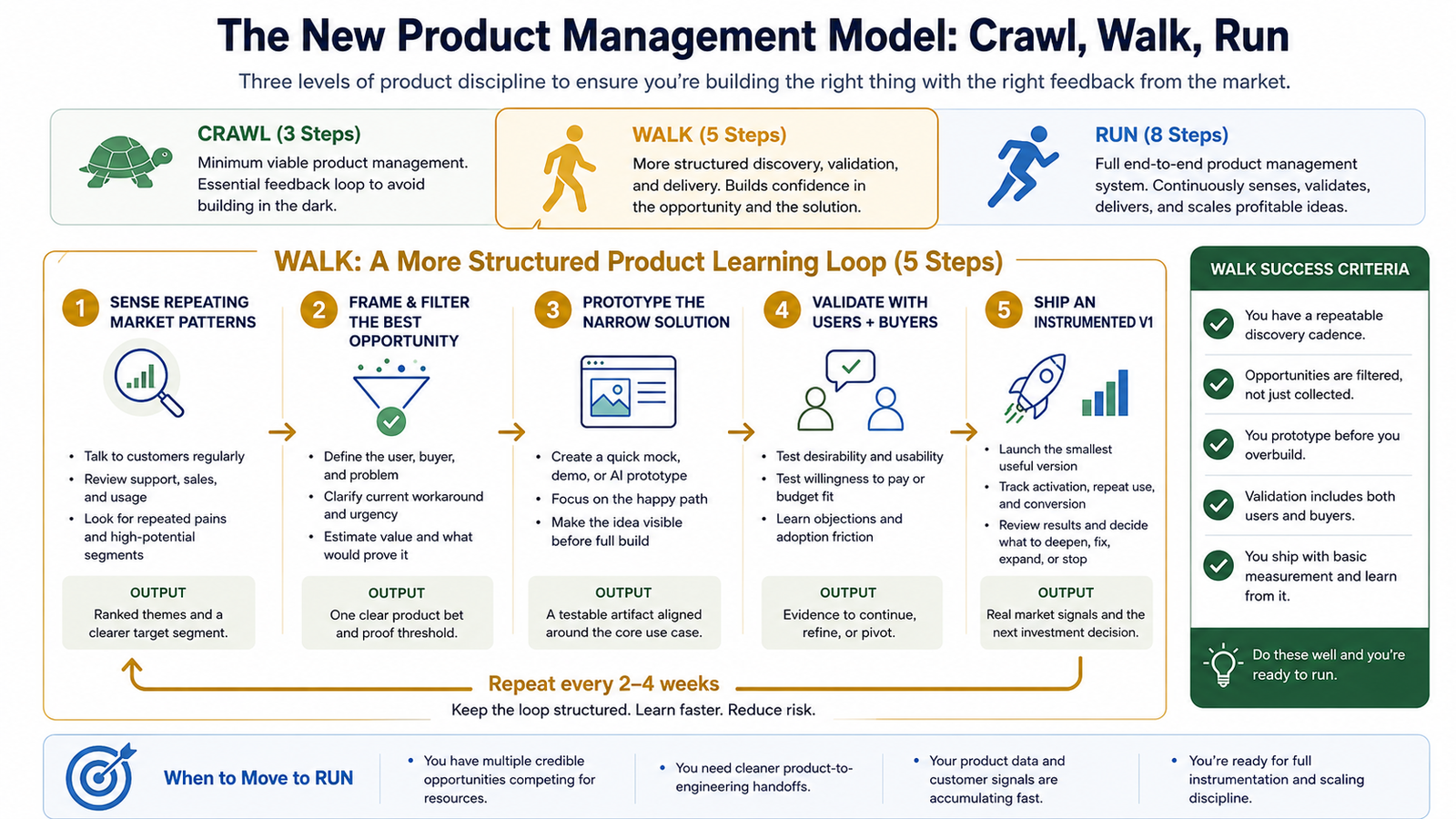
Sense Repeating Market Patterns → Frame & Filter the Best Opportunity → Prototype the Narrow Solution → Validate with Users + Buyers → Ship an Instrumented V1
Repeat every two to four weeks. Keep the loop structured. Learn faster. Reduce risk.
What to do
- Rank the patterns in your customer, sales, support and usage signals. Pick one segment.
- Write the bet in one paragraph, with the evidence that would prove it (Gilad, 2023).
- Prototype before you build, and test it with users and buyers (Cagan, 2017).
- Ship a small V1 with measurement built in, then decide: deepen, fix, expand, or stop.
Book a working session if you want help setting up this loop in your company.
Walk is where product discipline becomes repeatable
At Crawl, the team asks: what is one real problem we can test?
At Walk, it asks: which repeating market pattern deserves a real product bet?
The company stops reacting to the latest customer call or the loudest request. It compares opportunities, filters them, prototypes selectively, validates with users and buyers, and ships with basic measurement. Not a heavy system. Not a corporate process. A simple loop that runs on a schedule (Torres, 2021).
Step 1: Sense Repeating Market Patterns
Crawl listens for one real problem. Walk looks for patterns across many inputs: customer and prospect calls, support issues, sales objections, lost deals, churn reasons, expansion requests, implementation friction and usage data.
Early companies get pulled in every direction. One enterprise customer wants a compliance feature. A smaller customer wants self-serve. Sales wants a demo feature. Engineering wants platform cleanup. The founder sees a new market. All of it may be useful. Walk means looking across it and finding the strongest pattern.
The key question is:
What keeps showing up, and where does it point to a valuable opportunity?
The output of Step 1 should be:
Ranked themes and a clearer target segment.
Step 2: Frame & Filter the Best Opportunity
A pattern is not a product bet. Neither is a customer request. This step turns one into the other, and it is where the PM owns problem selection.
The team should be able to answer:
- Who has the problem, and who owns the budget or the outcome?
- What workaround do they use today?
- Why does it matter now?
- What would prove this is worth building?
A good Walk-stage bet fits in one paragraph:
“We believe [segment] has a recurring problem with [problem]. Today they solve it by [workaround], which costs them [time, money, risk or churn]. A narrow solution that [direction] would be valuable because [value]. We will know we are right if [proof threshold].”
The proof threshold matters most. Without it, teams drift into open-ended building. Decide in advance what evidence means continue and what means stop (Gilad, 2023).
The output of Step 2 should be:
One clear product bet and a proof threshold.
Step 3: Prototype the Narrow Solution
Do not prototype the whole vision. Prototype the smallest visible version of the best opportunity: a clickable mock, a demo, an AI-built prototype, a workflow simulation, or a concierge-backed version.
Show the core use case, the happy path and the moment the user gets value. Then ask: does the user understand it, does it match how they really work, and what is missing?
AI makes this step much cheaper. A team can go from a written description to something people can click in days, not weeks. Use that speed to reduce uncertainty, not to polish a demo.
The output of Step 3 should be:
A testable artifact aligned around the core use case.
Step 4: Validate with Users + Buyers
This is one of the biggest upgrades from Crawl. Walk tests both sides of a B2B sale explicitly:
- Users: does it fit the workflow, is it usable, will they change behavior?
- Buyers: is there budget, urgency, willingness to pay, and a reason to switch?
A user may love the idea and have no authority to buy. A buyer may like the business case and underestimate adoption friction. Value risk and viability risk are different risks, and both need evidence (Cagan, 2017).
Listen for the difference between polite interest and real signal. “That’s interesting” and “send me more information” are polite interest. “What would this cost?” and “when can we try it?” are signal. Compliments are not commitments (Fitzpatrick, 2013).
The output of Step 4 should be:
Evidence to continue, refine, or pivot.
Step 5: Ship an Instrumented V1
At Crawl, measurement can be basic. At Walk, the release is a deliberate learning system.
The V1 should still be small and narrow. But before it ships, the team should define the value moment, the behavior that shows a user reached it, and the signals that would mean confusion or weak demand (Croll & Yoskovitz, 2013). Typical signals: activation, completion, repeat use, conversion, time saved, and movement in the sales cycle.
That turns V1 from a launch milestone into a market sensor. Shipping is no longer the end of the product conversation. It is the start of the evidence conversation (Perri, 2018).
The output of Step 5 should be:
Real market signals and the next investment decision: deepen, fix, expand, reposition, or stop.
Who owns Walk?
At Crawl, the founder can run the loop personally. At Walk, someone needs to be clearly accountable for it: a first PM, a fractional PM, or a founder who formally takes the product lead role.
That owner does more than manage a backlog. They turn customer input into ranked themes, frame the bet, set the proof threshold, get the prototype made, run validation with users and buyers, define the smallest useful V1, make sure it is measured, and drive the next decision.
Walk success criteria
A company is doing Walk well when five things are true:
- You have a repeatable discovery cadence.
- Opportunities are filtered, not just collected.
- You prototype before you overbuild.
- Validation includes both users and buyers.
- You ship with basic measurement and learn from it.
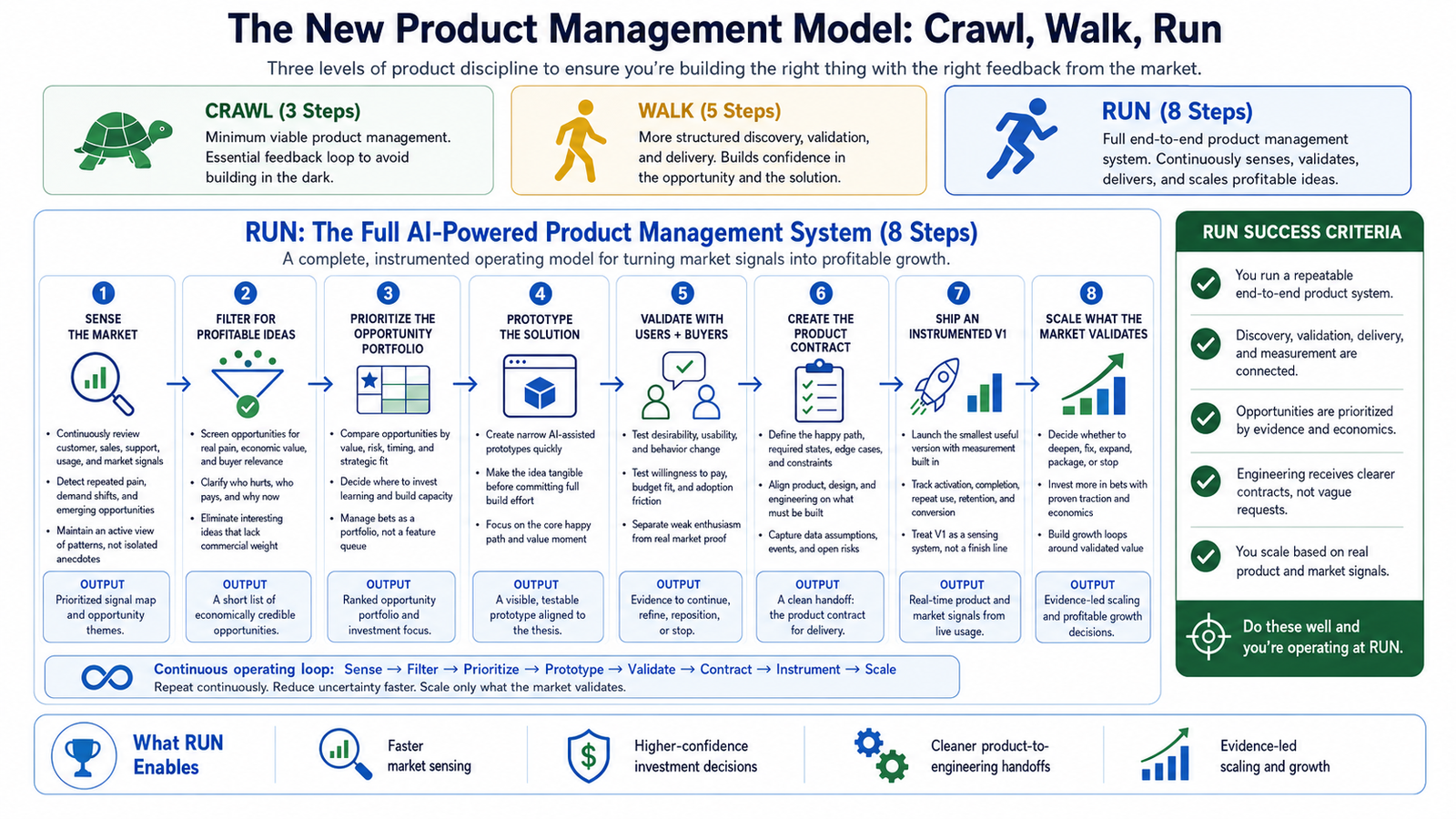
Do these well and you are ready to run.
When to move from Walk to Run
Move to Run when the loop generates more than the Walk system can handle:
- Several credible opportunities are competing for resources.
- You need cleaner product-to-engineering handoffs.
- Product data and customer signals are piling up fast.
- You are ready for full instrumentation and scaling discipline.
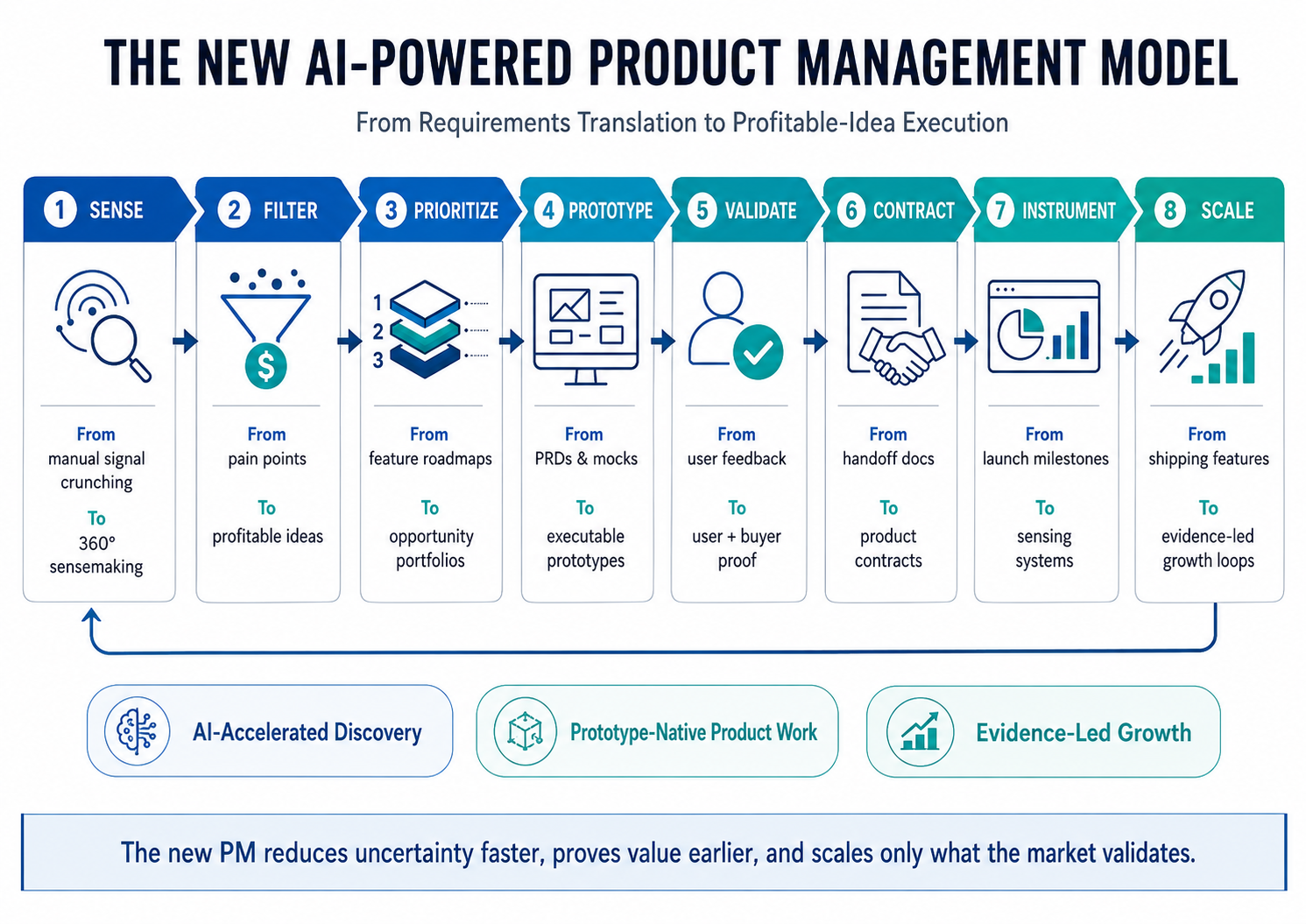
At that point the company needs the full eight steps: Sense, Filter, Prioritize, Prototype, Validate, Contract, Instrument, Scale. That is the Run version.
The Walk principle
Do not just collect signals. Rank them. Do not just pick ideas. Filter them. Prototype before you build. Validate with buyers, not just users. Measure what you ship, then decide.
Crawl helps a company avoid building in the dark.
Walk helps a company build confidence before it invests.
Run helps a company scale what the market validates.
Want help installing the loop? Book a working session.
References
Cagan, M. (2017). The four big risks. Silicon Valley Product Group. https://www.svpg.com/four-big-risks/
Croll, A., & Yoskovitz, B. (2013). Lean analytics: Use data to build a better startup faster. O’Reilly Media. https://www.oreilly.com/library/view/lean-analytics/9781449335687/
Fitzpatrick, R. (2013). The mom test: How to talk to customers and learn if your business is a good idea when everyone is lying to you. https://www.momtestbook.com/
Gilad, I. (2023). Evidence-guided: Creating high-impact products in the face of uncertainty. https://itamargilad.com/book-evidence-guided/
Perri, M. (2018). Escaping the build trap: How effective product management creates real value. O’Reilly Media. https://melissaperri.com/book
Torres, T. (2021). Continuous discovery habits. Product Talk. https://www.producttalk.org/continuous-discovery-habits/
The New Product Management Model series