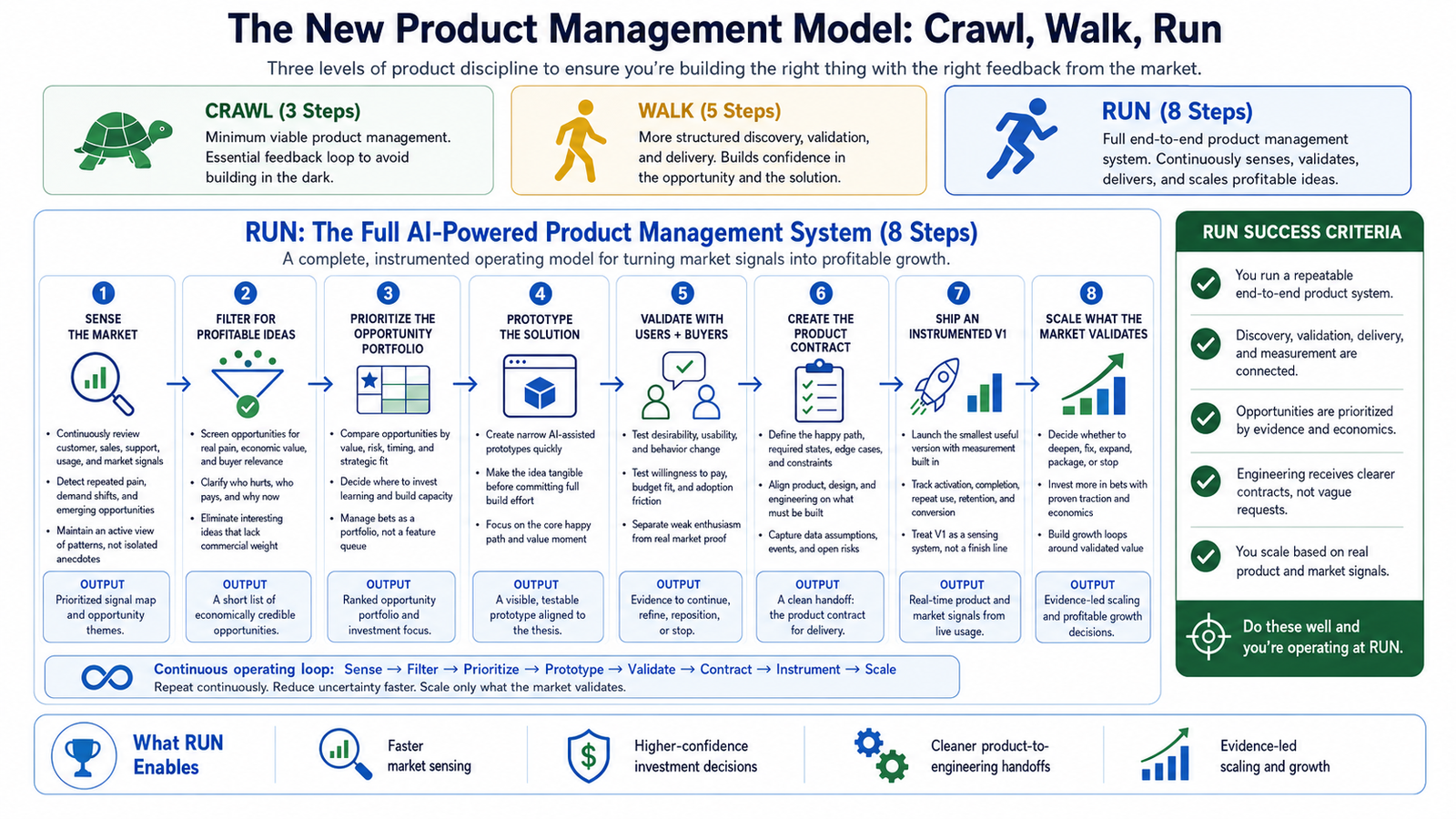
The new AI-powered product management model has eight steps: Sense, Filter, Prioritize, Prototype, Validate, Contract, Instrument, Scale. That is the destination. It is not where an early company starts.
Who this is for: founders and CEOs of early-stage B2B software companies who still run product themselves.
A company with a founder, a handful of engineers, and its first customers does not need a product operating system. It needs to stop building in the dark.
That is the Crawl version.
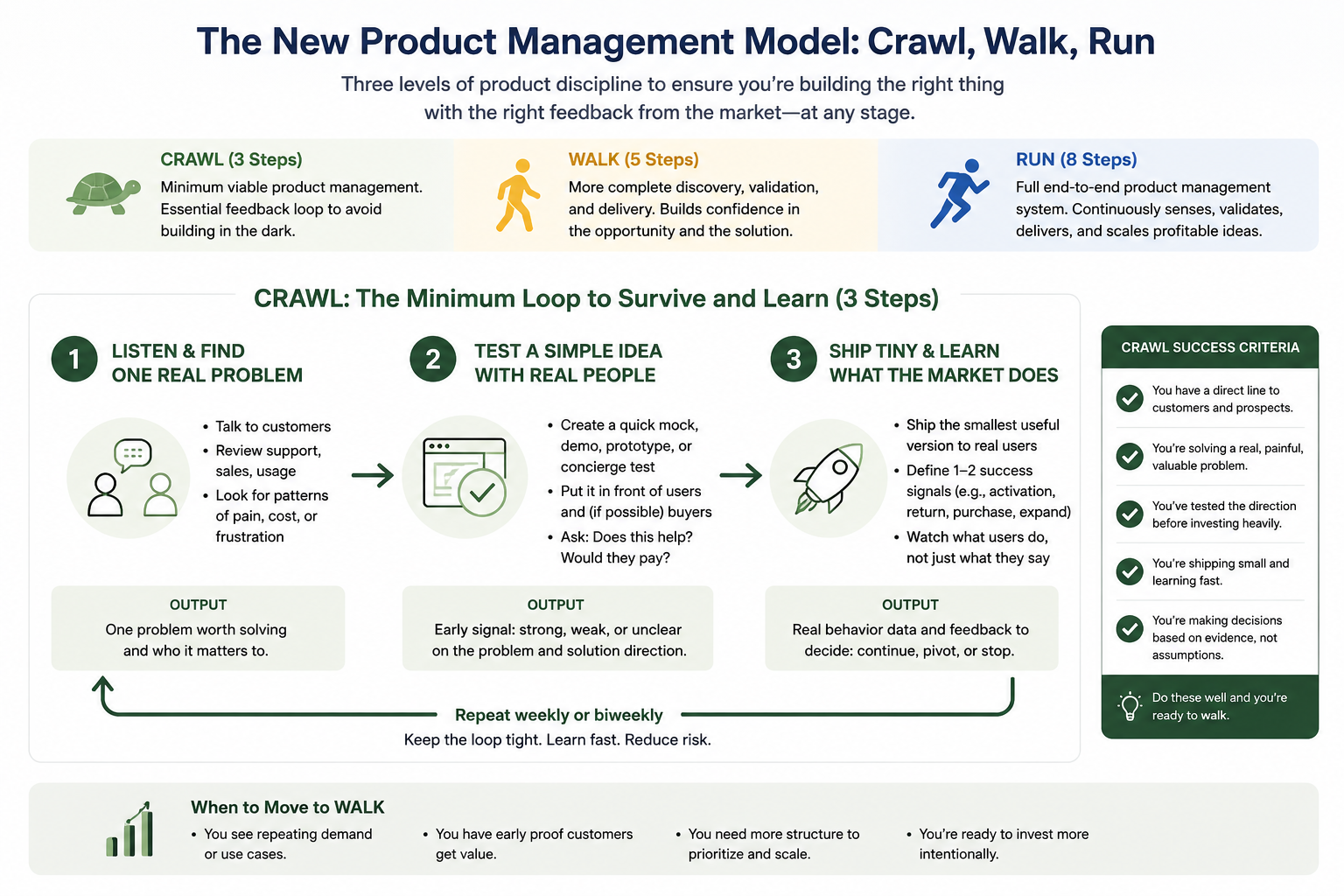
Crawl is minimum viable product management. It is the smallest loop that keeps a company connected to real customer pain, real reactions to a simple idea, and real market behavior.
Listen & Find One Real Problem → Test a Simple Idea with Real People → Ship Tiny & Learn What the Market Does
Repeat weekly or biweekly. Keep the loop tight. Learn fast. Reduce risk.
What to do
- Find one real problem and name who has it.
- Test a simple version with users and, where you can, buyers before you build (Cagan, 2017).
- Ship the smallest useful version, watch behavior, and decide: continue, pivot, or stop (Ries, 2011).
Book a working session if you want help setting up this loop in your company.
Crawl is about survival learning
At Crawl, the company is not comparing a portfolio of opportunities. It does not have one yet.
It is trying to answer a simpler question:
“Are we solving a real, painful, valuable problem for someone who will use what we build?”
The expensive failure at this stage is rarely bad code. It is building something nobody wants, for too long, without checking (Ries, 2011). Shipping more does not fix that. Output is not the same as outcomes (Perri, 2018).
Crawl exists to shorten that distance.
Step 1: Listen & Find One Real Problem
The first Crawl step is to listen and find one real problem.
Not ten problems. One.
The team should:
- Talk to customers.
- Review support, sales, and usage.
- Look for patterns of pain, cost, or frustration.
The key question is:
Where does it hurt, and who does it hurt?
At this stage the inputs are messy. A few customer calls. A handful of support tickets. A sales conversation that went sideways. Some usage data that may or may not mean anything.
That is fine. Crawl does not need perfect data. It needs the discipline to look, and to keep looking every week rather than once a quarter (Torres, 2021).
The output of Step 1 should be:
One problem worth solving and who it matters to.
If the team cannot name the problem and the person who has it, it is not ready to build.
Step 2: Test a Simple Idea with Real People
The second Crawl step is to test a simple idea with real people.
Before writing serious code, make the idea visible. That might be:
- A quick mock.
- A demo.
- A prototype.
- A concierge test, where the team delivers the value by hand before automating it (Ries, 2011).
Put it in front of users and, if possible, buyers. Then ask two questions:
- Does this help?
- Would you pay for it?
Those two questions map to the two risks that kill most early products: whether people will use it, and whether the business can work (Cagan, 2017).
AI makes this step cheaper than it used to be. In a small McKinsey study of 40 product managers, generative AI improved PM productivity by 40 percent (Gnanasambandam et al., 2024). Use that speed to test more ideas earlier, not to build more of the first one.
The output of Step 2 should be:
An early signal: strong, weak, or unclear on the problem and the solution direction.
Unclear is a real answer. It means test again, not build anyway.
Step 3: Ship Tiny & Learn What the Market Does
The third Crawl step is to ship tiny and learn what the market does.
Ship the smallest useful version to real users. Before it goes out, define one or two success signals (Croll & Yoskovitz, 2013). For example:
- Activation.
- Return use.
- Purchase.
- Expansion.
Then watch what users do, not just what they say.
People are generous in conversations. Compliments are not commitments (Fitzpatrick, 2013). A customer who says “this is great” and never logs in again has told you something important.
The output of Step 3 should be:
Real behavior data and feedback to decide: continue, pivot, or stop.
The Crawl loop
The Crawl loop repeats weekly or biweekly:
- Listen & Find One Real Problem
- Test a Simple Idea with Real People
- Ship Tiny & Learn What the Market Does
Then repeat.
The cadence matters more than the sophistication. A tight loop run every week beats an elaborate process run once a quarter.
Who owns Crawl?
At Crawl, the founder usually owns the loop.
That is not a failure of organization. It is the right design for the stage. The founder is closest to customers, closest to the vision, and closest to the money.
What matters is that someone owns it explicitly. If everyone is responsible for listening to customers, no one is.
Crawl success criteria
A company is doing Crawl well when five things are true:
- You have a direct line to customers and prospects.
- You are solving a real, painful, valuable problem.
- You have tested the direction before investing heavily.
- You are shipping small and learning fast.
- You are making decisions based on evidence, not assumptions (Gilad, 2023).
Do these well and you are ready to walk.
When to move from Crawl to Walk
The company is ready to move to Walk when:
- You see repeating demand or use cases.
- You have early proof customers get value.
- You need more structure to prioritize and scale.
- You are ready to invest more intentionally.
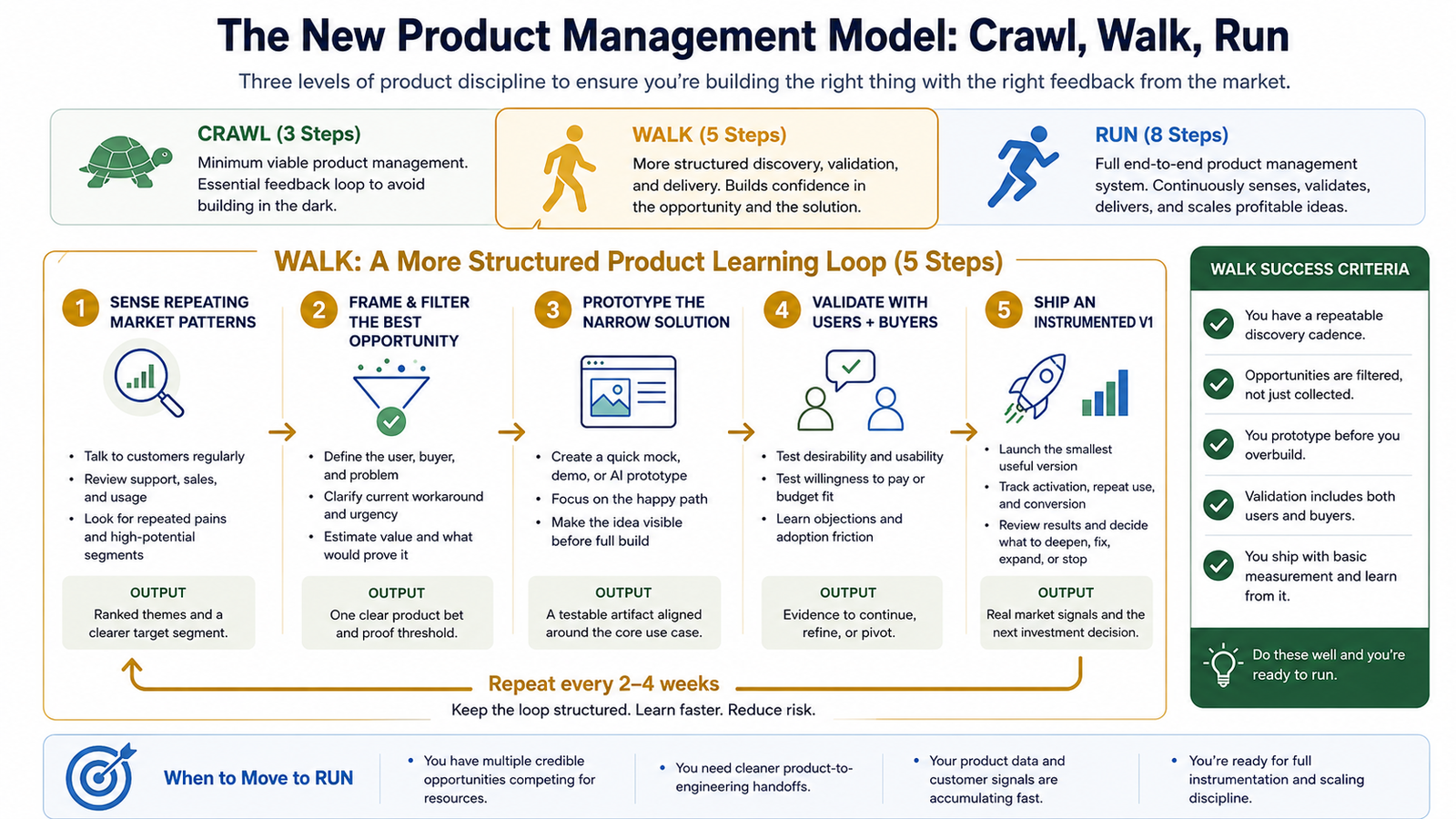
At that point, one real problem is no longer enough. The company needs to rank repeating patterns, filter for the best opportunity, and validate with both users and buyers. That is the Walk version of the model, coming next in this series.
The Crawl principle
The Crawl version of the new product management model is simple:
Find one real problem. Test before you build. Ship small. Watch what people do. Decide.
Crawl helps a company avoid building in the dark.
Walk helps a company build confidence before it invests.
Run helps a company scale what the market validates.
Want help installing the loop? Book a working session.
References
Cagan, M. (2017). The four big risks. Silicon Valley Product Group. https://www.svpg.com/four-big-risks/
Croll, A., & Yoskovitz, B. (2013). Lean analytics: Use data to build a better startup faster. O’Reilly Media. https://www.oreilly.com/library/view/lean-analytics/9781449335687/
Fitzpatrick, R. (2013). The mom test: How to talk to customers and learn if your business is a good idea when everyone is lying to you. https://www.momtestbook.com/
Gilad, I. (2023). Evidence-guided: Creating high-impact products in the face of uncertainty. https://itamargilad.com/book-evidence-guided/
Gnanasambandam, C., Harrysson, M., Singh, R., & Yarlagadda, C. (2024, May 31). How generative AI could accelerate software product time to market. McKinsey & Company. https://www.mckinsey.com/industries/technology-media-and-telecommunications/our-insights/how-generative-ai-could-accelerate-software-product-time-to-market
Perri, M. (2018). Escaping the build trap: How effective product management creates real value. O’Reilly Media. https://melissaperri.com/book
Ries, E. (2011). The lean startup. Crown Business. https://www.penguinrandomhouse.com/books/306999/the-lean-startup-by-eric-ries/
Torres, T. (2021). Continuous discovery habits. Product Talk. https://www.producttalk.org/continuous-discovery-habits/